


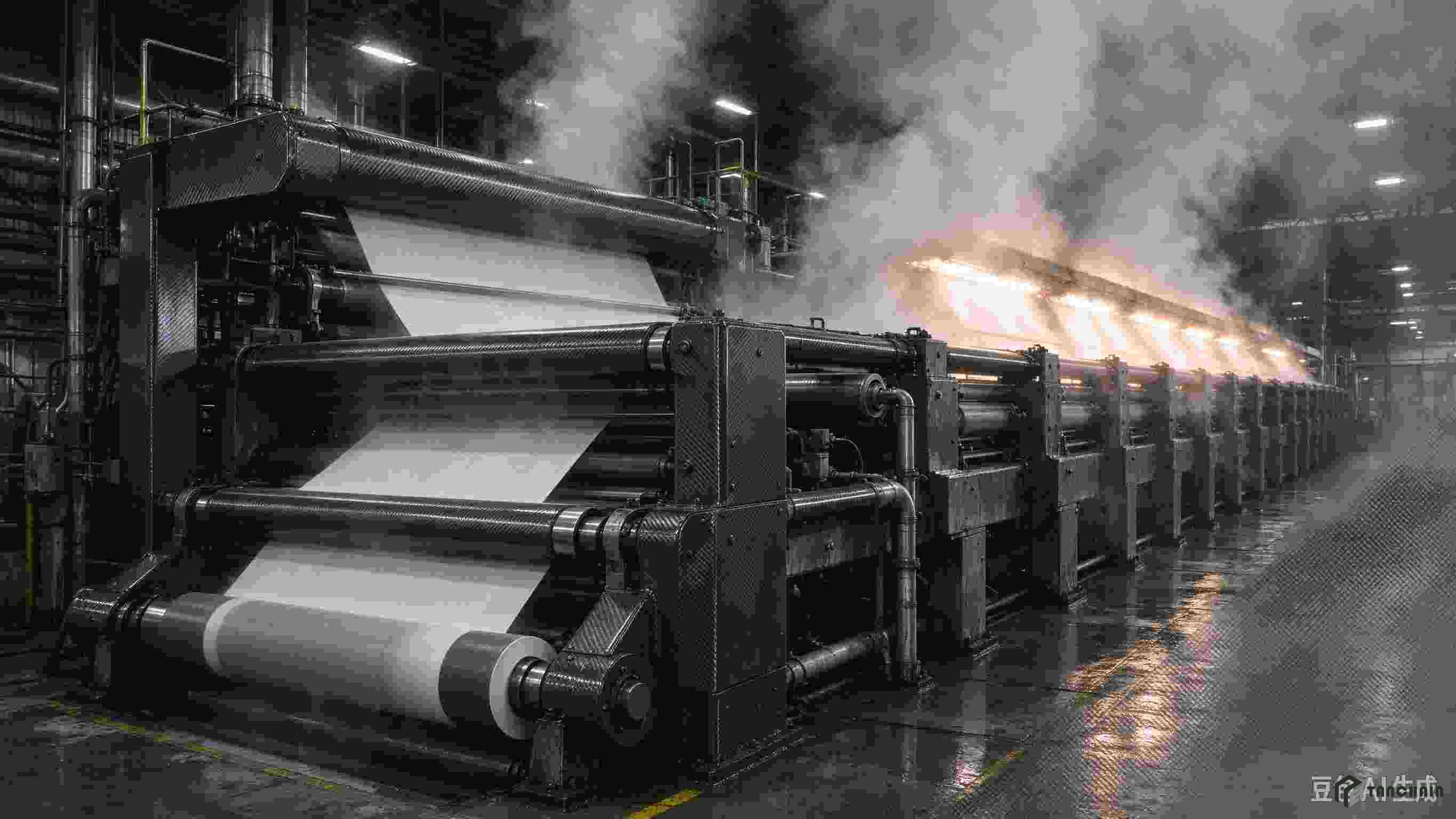
The pulp and paper mill is one of the harshest environments in heavy industry, and it is also one where the traditional materials struggle most. A mill combines continuous moisture, hot black liquor, caustic soda, chlorine dioxide, hydrogen peroxide, elevated temperatures and constant vibration in the same building. Stainless steel corrodes at the weld seams and gains weight where it can least afford to, aluminium is attacked by alkaline process liquor, and timber structures lose stiffness as they absorb water. Carbon fiber and aramid composites have moved into this environment slowly and deliberately, not as a replacement for every structure, but where the combination of low mass, chemical stability and fatigue resistance decides whether a machine runs through a grade change or stops for repair. This guide is written for mill engineers, maintenance managers and equipment OEMs who need to move from a wet-end or dryer-section problem to a material specification that will survive twenty years of it.
1. The Pulp and Paper Environment: What Actually Attacks a Material
Before any composite can be justified, the duty has to be understood in terms of chemistry, temperature and load. A paper machine is not a single environment; it is a sequence of process zones, and each zone exposes a different structure to a different combination of conditions. A material that performs well on a forming table may fail within months in a bleach plant hood.
1.1 The Corrosive Chemistry of the Mill
Process streams in a mill are alkaline or acidic depending on the stage, and most are also hot. Digester liquor carries sodium hydroxide and sodium sulphide. The bleach plant introduces chlorine dioxide, hypochlorite and peroxide, all of which find the weak points of metals in weld heat-affected zones and crevices under fasteners. Paper machine white water is mildly acidic to alkaline and saturated with fines and dissolved salts that settle into any gap and stay there. Each of these chemistries selects a different failure mode, and a composite solution only works when the resin system is chosen for the specific stream rather than for composites in general.
1.2 Heat, Steam and Condensation Cycles
Dryer sections operate under saturated steam, and the hood spaces above them cycle between hot humid air and cooler air at shutdown. A part that is dimensionally stable at operating temperature may distort when the machine stops and the hood cools, and the resulting movement is transferred into whatever it is bolted to. Thermal expansion behaviour and moisture absorption therefore have to be considered together, not as separate properties.
1.3 Abrasion, Vibration and Continuous Loading
A paper machine runs continuously for weeks. Stock pipework vibrates, couch and wire return rolls rotate at speed, and doctor blades bear against roll surfaces with constant pressure. Fatigue, not ultimate strength, governs the life of most components in a mill, and the alternative to a fatigue failure is usually a heavy steel structure designed with a generous safety factor that the machine frame then has to carry.
1.4 What This Means for a Material Decision
The consequence is that composite substitution in a mill almost never succeeds as a wholesale replacement of a material. It succeeds component by component, where a specific structure is losing money through corrosion, mass or maintenance frequency, and where the alternative can be supplied in a documented, repeatable form. The following sections follow that path through the mill.
2. Where Carbon Fiber Composites Fit in a Paper Mill
The practical route into a mill is through the components where the process itself causes the failure. These are the areas where composite conversion has become established.
2.1 Rolls, Doctor Blades and Lightweight Rotating Equipment
Reducing the mass of a rotating roll reduces the energy needed to accelerate it, the load on bearings, the vibration transmitted into the machine frame, and the severity of a felt or web break. Carbon fiber tube sections, produced by pultrusion or filament winding, have become a working option for guide rolls, spreader rolls, wire return rolls and lightweight idler positions where the process conditions stay below the limit of the resin system.
Doctor Blade Holders and Beam Structures
The beam that carries a doctor blade must be stiff along its whole length so that the blade loads the roll evenly. A carbon fiber plate or carbon fiber tube beam achieves that stiffness at a fraction of the steel mass, which shortens the changeover and reduces the deflection that causes uneven doctoring and streaking.
Idlers, Tensioners and Web Guiding Hardware
Web guiding frames, tension and draw-control hardware and slitter components all benefit from stiff, light structures that respond quickly without overshoot. The low mass of a carbon fiber frame lets a guiding actuator correct faster, and the damping of the laminate reduces the ringing that shows up as edge misalignment.
2.2 Wet-End and Stock Preparation: Pipes, Tanks and Covers
The wet end is where corrosion and abrasion meet. Carbon fiber composite pipe and ducting, tanks, machine covers and splash guards resist many process streams that attack steel at welded joints, and because they are moulded or wound rather than welded, they present no heat-affected zone to start a corrosion cell.
Machine Covers, Hoods and Access Platforms
Walkways, access platforms and machine covers built from carbon fiber plate over a lightweight core stay stiff when wet, do not corrode under washdown and reduce the structural load on the machine frame. Aramid fabric can be used on contact and impact surfaces where maintenance traffic and dropped tools are the dominant wear mechanism.
Stock Screening and Cleaning Components
Screen baskets, hydrocyclone components and valve trim sit in abrasive stock flow at high velocity. Composite liners and wear parts reduce the mass that has to be supported, resist the chemistry of the stock, and can be replaced as an insert rather than as a whole component.
2.3 Dryer Section: Insulation, Steam and Heat Containment
The dryer section is the part of the mill where pre-oxidized fiber (PANOX) becomes the material of choice rather than a supplement. Steam pipes, dryer cans, condensate systems and hood ducting all need thermal insulation that holds its performance when wet, does not support combustion and does not degrade into a dust that contaminates the sheet.
Pre-Oxidized Fiber Felt, Fabric and Yarn
Pre-oxidized fiber felt is thermally stable, flame resistant, chemically robust and non-conductive. It is used as insulation around steam and condensate lines, backing fabric for heat shields, gaskets and seals in hot areas, and filtration media where the process is too hot for standard synthetic felt. Pre-oxidized yarn is woven into sleeve and wrap forms that are fitted around pipework in service.
Expansion Joints and Flexible Connectors
Hot ducting moves, and the flexible connector between a duct and the hood has to absorb that movement while staying sealed. Aramid fabric contributes strength and tear resistance to flexible connectors and expansion joints, while pre-oxidized fiber layers provide the thermal and flame barrier.
2.4 Structural and Maintenance Applications
A large part of the composite opportunity in a mill is not in new equipment but in the structures that keep the mill standing and running.
Carbon Fiber Fabric for Repair and Reinforcement
Bonded carbon fiber fabric is a practical way to restore or increase the capacity of concrete floors, beams and supports, and of steel structures, without taking the line out of service. In a mill, this is often applied to machine foundations, roll grinder bases, clarifier walls and pumping station structures where a full structural replacement is impossible. Because the repair is bonded rather than welded, no hot work permit is required in an area where paper dust and solvent vapour make hot work expensive.
Pipe Supports, Brackets and Retrofits
Pultruded carbon fiber profiles make stiff, corrosion-free supports for pipework and cable trays, and machined carbon fiber plate brackets replace rusting steel in splash zones. These are small items, but in a mill they are the source of a disproportionate share of maintenance labour.
2.5 Electrical and Control Areas
Variable speed drives, motors, sensors and instrumentation spread through the mill bring their own requirements. Pre-oxidized fiber is naturally non-conductive and flame resistant, so it suits cable insulation, motor insulation components, arc barriers and equipment enclosures. Carbon fiber's electrical conductivity is useful in a different way, providing static dissipation and shielding where drives and high-frequency equipment generate interference.
3. The Performance Case: Why Composites Win in a Mill
The case for composites in this industry rests on a small number of properties, and each one answers a failure that mill engineers already know well.
3.1 Corrosion Resistance Where It Counts
A composite part is not immune to chemistry, but it does not corrode the way steel does. There is no electrochemical cell, no rust that flakes away and hides thinning, and no weld seam that becomes the first point of failure. With the correct resin and a sealed surface, a composite component in a bleach plant or white water circuit can remain stable for the life of the machine.
3.2 High Specific Stiffness and Low Rotating Mass
Carbon fiber reinforced polymer delivers stiffness comparable to steel at roughly a quarter of the density. In rotating equipment this multiplies: a lighter roll needs smaller bearings, accelerates faster, transmits less vibration into the frame and can be handled by fewer people during a maintenance outage. This is the strongest single argument for carbon fiber in a paper machine.
3.3 Fatigue Life Under Continuous Load
A paper machine does not stop, and its components see tens of millions of load cycles in a year. Carbon fiber laminates have excellent fatigue resistance when the lay-up and the load path are designed together, and they do not develop the small cracks at stress concentrators that lead to a metal fatigue failure.
3.4 Dimensional Stability Through Temperature and Moisture Cycles
Carbon fiber has a low coefficient of thermal expansion, and a balanced laminate can be designed so that the structure keeps its geometry when the hood cools or the machine is washed down. That predictability is what allows a composite component to be installed as a direct replacement without reworking the surrounding machine.
3.5 Flame Resistance and Thermal Stability
Pre-oxidized fiber and aramid offer flame resistance without the melting behaviour of standard synthetic fibers, and without the conductivity of carbon fiber. In a mill where paper dust creates a fire risk and where hot steam lines run through occupied areas, this combination is a genuine safety and insurance consideration.
3.6 Low Maintenance and Fast Turnaround
The value of a composite in a mill is often measured in outage time, not in purchase price. A part that can be carried by two technicians, fitted without welding, and does not need repainting or replacing on a two-year cycle changes the maintenance plan. In continuous processes, the avoided downtime is usually the entire justification.
4. Selection Matrix: Mill Component to Product Form
The table below is a first pass from the mill duty to a recommended product form. It is intended to start a specification conversation, not to replace engineering judgement, because two similar components can need different fibre architectures once the process zone and the load path are considered.
| Mill component | Recommended product form | Deciding property | Priority |
|---|---|---|---|
| Guide rolls, spreader rolls, wire return rolls | Carbon fiber tube, filament wound or pultruded | Low rotating mass, stiffness, fatigue | High |
| Doctor blade holders and beams | Carbon fiber plate, carbon fiber tube | Stiffness along length, low deflection | High |
| Web guiding frames and slitter hardware | Carbon fiber plate, machined composite | Fast response, damping, low mass | Medium |
| Process piping and ducting in corrosive zones | Carbon fiber composite pipe and profile | Chemical resistance, no weld seam | High |
| Machine covers, hoods and splash guards | Carbon fiber plate, sandwich panel | Wet stiffness, corrosion, low weight | High |
| Access platforms and walkways | Carbon fiber plate over core | Stiffness when wet, load capacity | Medium |
| Dryer and steam line insulation | Pre-oxidized fiber felt, fabric, yarn sleeve | Thermal stability, flame resistance | High |
| Hot duct expansion joints | Aramid fabric with pre-oxidized fiber barrier | Tear strength, heat and flame barrier | High |
| Screen and cyclone wear parts | Composite liners, aramid fabric reinforcement | Abrasion resistance, chemical resistance | Medium |
| Machine foundation and concrete repair | Carbon fiber fabric, laminates | Tensile capacity, no hot work | High |
| Pipe supports and splash-zone brackets | Pultruded carbon fiber profile, plate | Corrosion resistance, stiffness | Medium |
| Motor and drive insulation, arc barriers | Pre-oxidized fiber felt and fabric | Non-conductivity, flame resistance | Medium |
| Protective covers and impact guards | Aramid fabric, aramid fiber | Impact and abrasion resistance | Medium |
5. Implementation Notes: What Decides Success or Failure
The composites themselves rarely fail the mill test; the way they are specified and installed usually does. These are the points we raise before a programme moves to tooling.
5.1 Match the Resin to the Process Stream
Generic laminating resin is a poor choice in a mill. The resin system has to be selected for the specific chemistry it will face, whether that is alkaline digester liquor, chlorine dioxide in the bleach plant, peroxide in a brightening stage or the near-neutral white water circuit. Confirm the process stream, its concentration, its temperature and its cleaning chemistry before the laminate is specified.
5.2 Design the Metal-to-Composite Joint Properly
Every composite component in a mill meets steel at a flange, a bearing housing or a fastener. The joint must distribute preload without crushing the laminate, and it must interrupt galvanic coupling between carbon fiber and metal wherever moisture is present. Insulating sleeves, washers and controlled torque are design details that decide whether the joint survives a decade of washdown.
5.3 Respect the Temperature Limit of the Whole System
Carbon fiber itself is stable far beyond any paper machine temperature. The resin, the core, the adhesive and the sealant are not. The working temperature of a component is therefore the working temperature of its weakest constituent, and that is what has to be quoted when the part is specified for a dryer hood or a steam line.
5.4 Plan for Impact and Maintenance Traffic
Carbon fiber is stiff and strong in tension and compression along the fibre, but it is not tolerant of point impact. Where a component will be struck by tools, dragged across a floor or stood on, an aramid face ply, an aramid protective cover or a suitable core design should be part of the specification from the start rather than added after the first damaged part.
5.5 Document the Lay-Up, Cure and Inspection Record
A mill owner has to be able to defend the component during an insurance inspection and to repeat the order ten years later. Fibre content, lay-up schedule, cure cycle, mechanical test results and dimensional inspection should be recorded for each lot, and the supplier should be able to reproduce them.
5.6 Verify the Interface to the Existing Machine
Most mill composites are retrofits. The bolt circle, centre height, face-to-face dimension, journal diameter or flange pattern of the installed machine usually constrains the design more tightly than the material. Those interfaces should be measured on site, not taken from a drawing that may not reflect the machine as built.
6. Complementary Materials That Complete the Solution
A working mill installation is almost never carbon fiber alone. The other two fibre families in the same product range handle the duties that carbon fiber performs badly, and specifying them deliberately is what makes the package complete.
6.1 Aramid Fiber for Impact, Wear and Flexibility
Aramid fabric and aramid fiber absorb impact energy far better than carbon fiber, are resistant to abrasion and remain flexible. They suit protective covers, wear surfaces, expansion joints, conveyor and belt components, seals and the contact faces of splash guards. In hybrid laminates, an aramid ply on the outer surface of a carbon structure adds impact tolerance without giving up the stiffness underneath.
6.2 Pre-Oxidized Fiber for Heat, Flame and Electrical Safety
Pre-oxidized fiber (PANOX) filament, staple, yarn, fabric and felt provide flame resistance, thermal insulation and electrical non-conductivity at a cost that is practical for large surface areas. In a mill this means insulation blankets on steam lines, hot duct lagging, gaskets, seals and cable insulation, plus arc and fire barriers inside electrical enclosures.
6.3 Carbon Fiber Fabric for Repair and Retrofit
Where concrete or steel has lost capacity, bonded carbon fiber fabric restores tensile strength and bridges cracks in place. It is a dry, cold repair that needs no welding, which makes it suitable for occupied buildings and for structures that cannot be shut down.
7. Why Buyers Choose Tanchain for Pulp and Paper Composites
Tanchain supplies the material forms a mill project needs from one source: carbon fiber filament (tow), staple fiber, carbon fiber fabric, carbon fiber prepreg, carbon fiber plate, carbon fiber tube and pultruded profiles, machined composite components, together with aramid filament, aramid short fiber and aramid fabric, and the full pre-oxidized fiber range in filament, long filament, staple, yarn, fabric and felt. For a mill engineer, that means the roll, the doctor blade holder, the process duct, the insulation and the concrete repair can be specified as one consistent material system rather than assembled from suppliers who each optimise their own catalogue.
Because the components are engineered to the duty, the fibre architecture, the resin system, the surface protection and the joint design can all be matched to the specific process zone, the temperature envelope and the maintenance access of the installation. That match is what determines whether a composite component is still running after the second machine rebuild or has been quietly replaced by steel after the first season.
If you are evaluating a composite replacement for a roll, a doctor beam, a corrosive duct, a repair on a machine foundation or an insulation system in a dryer section, review our carbon fiber and high-performance fiber products or send us the duty conditions, the process chemistry and the interface dimensions, and we will recommend the specific product form and specification for each component. Carbon fiber composite solutions for pulp and paper mills start with one correct material decision in the right place.