


-
High-Performance Fibers in Marine Fire Safety: Pre-Oxidized, Aramid and Carbon Fiber Systems for Ships
-
How pre-oxidized fiber, aramid and carbon fiber are used in shipboard fire protection - fire-rated bulkheads, composite fire doors, fire curtains, cable penetrations, engine-room insulation and battery rooms - plus a specification checklist for yards and outfitters.
High-Performance Fibers in Marine Fire Safety: How Ships Meet Fire Standards Without Adding Steel
Ask a naval architect which fire requirement causes the most trouble and the answer is rarely the engine room. It is almost always the boundary. A fire-rated bulkhead or a fire door on a passenger vessel has to hold back flame and smoke for a defined period, stay within a tight weight budget, survive decades of salt and vibration, and still look like something a passenger is willing to sit next to. Steel does the fire part well and loses on everything else. Aluminium saves weight but melts at temperatures a hydrocarbon fire reaches in minutes.
This is where high-performance fibers earn their place in shipbuilding. Pre-oxidized fiber fabric, aramid fabric, carbon fiber reinforcement and hybrid laminates now form the working core of fire-rated walls, doors, curtains, cable penetrations and structural reinforcements on vessels of every size. This article maps where each material goes on a ship, what it contributes, and how yards and designers specify it so that a certificate at the test house becomes a compliant ship at delivery.
1. Why Fire Safety Is a Different Engineering Problem at Sea
A building fire has somewhere to go. A ship fire does not. The vessel is a sealed steel box full of fuel, people and sleeping quarters, usually far from a fire brigade. Every fire requirement on board follows from that single fact.
1.1 Escape time is measured in minutes, not hours
The regulatory framework makes the logic explicit. SOLAS sets the broader safety obligations, the Fire Safety Systems Code defines how escape routes, boundaries and detection must work, and the Fire Test Procedures Code defines the furnace tests that a product has to pass before it can be installed. A-rated divisions must resist fire and smoke for 30, 60 or 120 minutes depending on the space they protect, and the test includes a hose stream after the furnace period to prove the structure is still standing.
What matters for material selection is that these tests measure an assembly, not a sheet of material. Insulation, core, facings, joints and fixings all contribute, and a change in any one of them changes the result.
1.2 Weight is stability, range and cost
Every kilogram added above the waterline raises the centre of gravity and has to be paid for in ballast, beam or fuel. Fire protection is therefore in direct competition with the rest of the weight budget, and lightweight fire-rated structures are one of the few places where a shipyard can recover weight without giving up safety.
1.3 The environment attacks the protection itself
Salt spray, humidity, vibration and thermal cycling degrade materials that performed well in a dry test house. Mineral wool sags and settles when it is repeatedly shaken. Some intumescent coatings lose their adhesion in a marine atmosphere. Steel facings on doors corrode at the bottom edge, exactly where water collects. A marine fire system has to be specified against a twenty-five-year exposure, not a two-hour test.
2. The Fiber Families and What Each One Does on Board
Three families of high-performance fiber dominate marine fire work, and they are rarely used alone. Understanding which one carries which duty is the starting point for any practical specification.
2.1 Pre-oxidized fiber: the thermal barrier
Pre-oxidized fiber, sometimes called PANOX-type fiber, is made by heating acrylic precursor in air until the polymer forms a stable ladder structure. The result is a textile that will not melt, will not drip, and chars rather than burns. Its limiting oxygen index is high enough that it self-extinguishes once the ignition source is removed.
This is the material that does the thermal work in a fire-rated assembly. It appears on board as needled felt for insulation cores and back-up layers, as woven fabric for curtains, blankets and removable covers, as yarn for sewing thread and braided seals, and as staple fiber for blended nonwovens. Unlike glass, it does not shed irritating fibers during handling, and unlike aramid it keeps its integrity at temperatures well above the point where aramid starts to degrade.
2.2 Aramid fiber: strength that survives heat
Para-aramid is the structural fire fiber. It carries high tensile load, resists cutting and abrasion, and does not melt below the temperatures found in a compartment fire. On a vessel it appears in fire doors as internal reinforcement and hinge reinforcement, in fire curtains and smoke screens as the woven substrate, in cable trays and penetrations as a wrapping layer, and in firefighter and damage-control equipment.
Meta-aramid complements it where flexibility and comfort matter more than strength: fire blankets, protective clothing, cable wrapping tapes and soft smoke seals. Both aramids can be blended with pre-oxidized fiber to combine structural integrity with higher temperature tolerance.
2.3 Carbon fiber: structure that does not burn, but conducts
Carbon fiber reinforced polymer is not a fire barrier in the thermal sense, but it is an excellent structural material that does not contribute fuel. In marine fire safety it is used where a fire-rated structure also has to be light and stiff: door leaves on fast ferries and yachts, reinforcement of existing steel and aluminium structure during refit, ventilation trunking, and composite sandwich panels with a fire-rated core.
One caution belongs in every specification. Carbon fiber conducts electricity and is cathodic to steel and aluminium. Where a carbon structure meets a metal frame in a wet environment, the joint needs isolation, or the aluminium will corrode faster than the designer intended. This is a detail, but it is the detail that fails first.
3. Where These Materials Go on a Vessel
The application map below follows the way a ship is actually zoned, from the spaces where a fire is most likely to the routes people use to leave.
3.1 Fire-rated bulkheads and deck coverings
A-rated bulkheads are usually steel or aluminium faced with an insulation core. The core is where pre-oxidized felt and mineral blends do their work: it slows heat transfer so that the unexposed face stays below the specified temperature rise for the rating period. Pre-oxidized felt is attractive here because it holds its loft under vibration, does not corrode the facing, and can be needled to the density the fire test requires.
On aluminium structures the same insulation is more critical, because aluminium loses most of its strength well below the temperature a steel structure would tolerate. The insulation is not a comfort measure; it is what keeps the bulkhead from collapsing.
3.2 Fire doors, including the ones passengers actually use
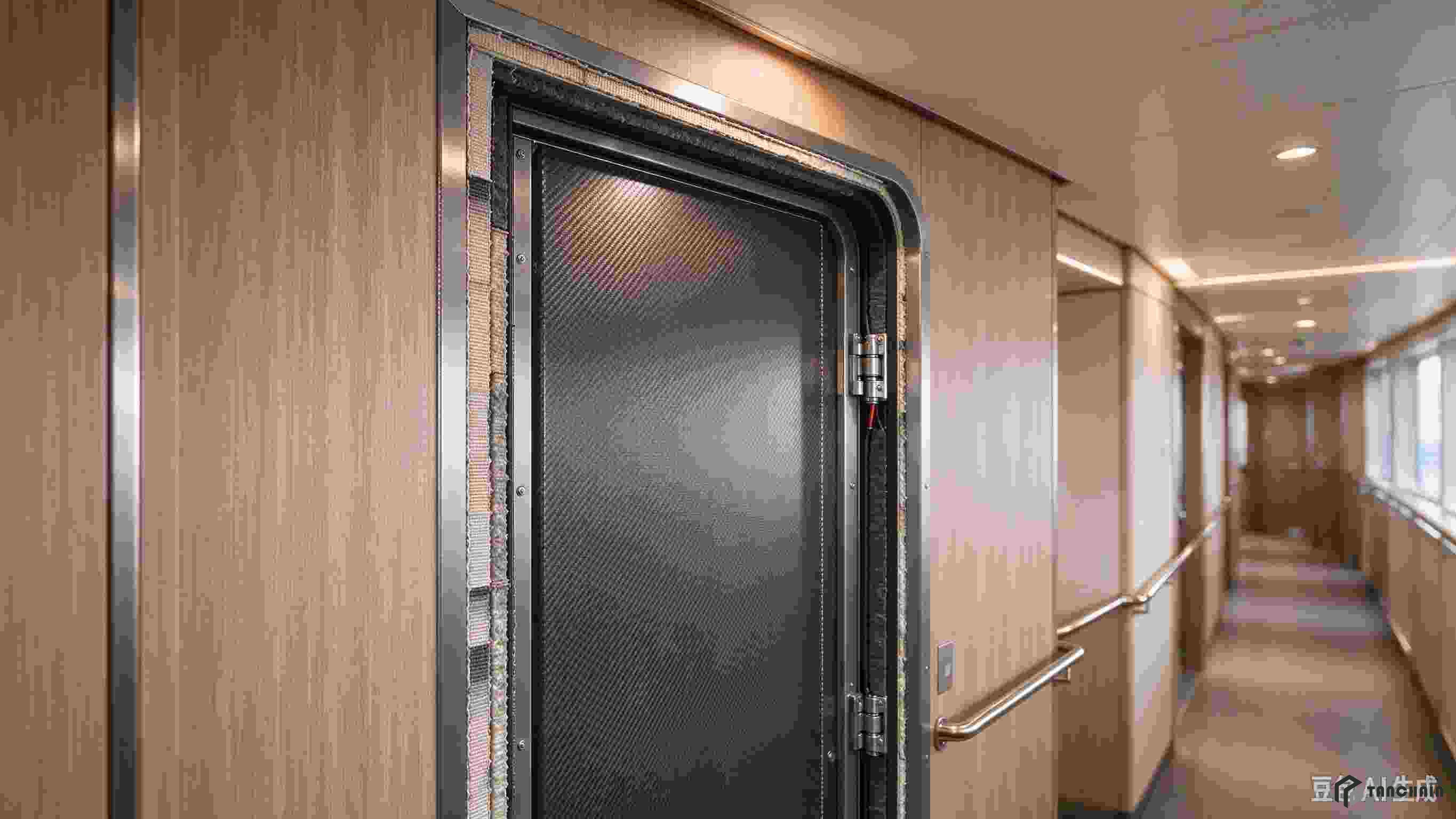
A fire door is the hardest component to get right because it has to pass a furnace test, close reliably thousands of times, and look acceptable in a public space. The typical lightweight leaf is a sandwich: a fire-rated core, aramid reinforcement around hinges and the lock area, and a decorative facing.
Pre-oxidized fabric is used as a flexible intumescent carrier and as a protective layer behind the facing. Aramid fabric reinforces the leaf where the hardware concentrates stress, so the door does not sag or delaminate after years of use. On cruise ships and ferries, where door weight directly affects the effort a passenger needs to open it, the composite leaf is also a comfort and accessibility decision.
3.3 Fire and smoke curtains
Fire curtains and smoke screens are folded or rolled into a headbox and drop automatically when detection triggers. They buy escape time in atria, stair openings and long corridors where a fixed bulkhead is impossible. The fabric must remain flexible through years of being folded, resist the heat of the fire below, and keep smoke passage low.
Pre-oxidized woven fabric, sometimes laminated to a foil or a coated backing, is the standard choice for the hot face. Aramid fabric serves the structural layers and the stitching. The selection point that matters most is the fold memory: a fabric that cracks along a fold line after a few thousand cycles will fail when it is asked to deploy.
3.4 Cable and pipe penetrations
A cable penetration is a small hole in a rated boundary, and it is statistically one of the most common paths for fire and smoke to cross that boundary. Modern penetration systems combine intumescent material that expands under heat with a flexible fiber wrap that holds the cable bundle together during the fire.
Pre-oxidized tape and aramid wraps are used as the carrier and reinforcement in these systems because they are thin enough to fit in a stuffing box, do not age in the presence of cable sheath plasticisers, and do not crumble when a cable is re-pulled during a refit.
3.5 Engine rooms, exhaust systems and hot surfaces
Engine rooms concentrate heat, fuel and noise in a small space. Pre-oxidized felt and fabric serve as removable insulation blankets on exhaust manifolds, turbocharger housings, hot piping and auxiliary equipment. Beyond fire protection, they lower surface temperature to protect personnel, reduce heat load on the compartment ventilation, and cut radiated noise.
Detachable blankets need a mechanically robust construction: an outer pre-oxidized fabric skin, an insulation core, and aramid thread that will not burn away when the blanket is exposed to a flame for its rated period.
3.6 LNG, battery rooms and alternative-fuel spaces
Gas-fuelled and battery-powered vessels bring new fire scenarios. LNG and methanol installations need thermal barriers around tanks and piping that stay effective at low temperature and under a hydrocarbon fire. Battery rooms need containment that resists a thermal runaway event, where the heat flux is intense and venting gases are flammable.
In these spaces the fiber package is chosen as a system: pre-oxidized felt for the thermal barrier, aramid fabric for mechanical containment, and carbon fiber reinforced panels where the enclosure also has to be light and stiff. The marine classification societies increasingly ask for documentation of the whole assembly rather than the individual materials, which is why source traceability matters as much as performance data.
4. Product Forms and How They Map to the Job
The same fiber chemistry behaves very differently depending on how it is presented. Yards and outfitters buy by form, and the form usually decides whether a material is practical to install.
4.1 Felt and nonwoven mat
Needled felt is the workhorse of thermal insulation. It is supplied in thicknesses from a few millimetres to several centimetres, in densities that trade insulating value against weight, and in rolls that cut easily on board. Its advantage in marine work is that it conforms to curved structures, does not shed like glass wool, and can be stitched or stapled without breaking down.
4.2 Woven fabric
Pre-oxidized and aramid fabrics in plain, twill and satin weaves are used for curtains, blankets, removable covers, penetration wraps and soft smoke seals. Areal weight and weave density control how the fabric drapes, how it resists abrasion, and how much smoke passes through. Coated and laminated versions add water resistance or reflect radiant heat.
4.3 Yarn, thread and braid
High-temperature sewing thread is the quiet enabler of marine fire textiles. A blanket or curtain stitched with polyester thread loses its seams at exactly the moment it is needed. Pre-oxidized and aramid threads keep the assembly together, while braided pre-oxidized cord is used as a seal or gasket in door and hatch applications.
4.4 Carbon fiber fabric, prepreg and plate
For structural fire-rated components, carbon fiber is supplied as woven fabric for hand lay-up and repair, as prepreg for autoclave or press curing of door leaves and panels, and as pultruded profiles or machined plate for frames and stiffeners. A fire-retardant resin system is normally specified for any interior application, and the resin choice can change the smoke and toxicity performance more than the fiber does.
4.5 Finished composite panels
Sandwich panels with a fire-rated core and composite or metal facings are supplied as finished bulkhead and ceiling systems. These are the units that carry the certificate, and they are installed as a system with matching jointing profiles, corner pieces and penetration details.
5. Specifying a Marine Fire Material That Actually Passes
The gap between a good material and a compliant ship is almost always in specification discipline. The following points decide most projects.
5.1 Specify the assembly, not the fiber
Ask the supplier for test evidence on the complete build-up: facing, core, adhesive, joint and fixing. A pre-oxidized felt that passed a furnace test at 40 mm thickness does not automatically pass at 25 mm, and it certainly does not pass if the metal facing changes from steel to aluminium.
5.2 Check the fire test standard against the flag state
Type approval under the relevant Marine Equipment Directive regime, certification to the Fire Test Procedures Code, and class society approvals are three different documents. A product may hold one and not the others. Confirm the exact certificate the vessel needs before the material is ordered, because re-testing late in a build is expensive and slow.
5.3 Match the temperature rating to the neighbour
Pre-oxidized fiber holds continuous service at temperatures that will destroy aramid and will soften many thermoplastics. Aramid is stronger but degrades earlier under sustained heat. Placing the material with the higher temperature tolerance against the hot face and the stronger material in the structural layers is the standard way to get both properties.
5.4 Design for water and salt
Insulation that stays wet loses most of its thermal value, and a wet core in a steel-facing door is a corrosion cell. Specify closed edges, drainage paths and non-wicking facings, and avoid detailing that traps water at the bottom of a door or a curtain headbox.
5.5 Control smoke and toxicity, not just flame
Most fire deaths on ships are caused by smoke rather than flame. Resin systems, adhesives, facings and coatings all contribute. Low-smoke, low-toxicity formulations exist for phenolics and modified epoxies, and they are worth the cost difference in accommodation spaces and on passenger vessels.
5.6 Plan the installation sequence
Fire protection installed after cabling and ducting is protection with holes in it. The most common non-conformity at delivery is an unsealed penetration added late in outfitting. Agree the sequence and the penetration register before the first panel goes up.
6. Weight, Cost and Compliance: Where the Trade-Offs Really Are
Composite and fiber-based fire systems cost more per square metre than mineral wool behind steel. The comparison only makes sense at the level of the whole structure.
A lightweight composite door leaf weighing a third of a steel leaf reduces hinge and frame loads, which allows a lighter frame, which reduces the reinforcement needed in the bulkhead behind it. On a large ferry or cruise vessel with hundreds of doors, the cascade reaches tonnes. The same logic applies to bulkhead panels on aluminium vessels, where every kilogram of insulation saving can reduce structural stiffening.
Cost also shifts from material to labour. Prefabricated panels and pre-cut felt reduce the hours spent on board, and shipyard labour is usually the largest single cost in outfitting. For a refit, a composite reinforcement bonded to an existing steel or aluminium structure can avoid hot work and the fire watch, gas freeing and permit costs that come with it.
7. Where Marine Fire Safety Is Heading
Three trends are shaping the next generation of fire-rated marine structures.
The first is the shift from prescriptive rules to performance-based approval. Designers increasingly want to show that a design achieves the required safety outcome, which favours materials with well-documented, repeatable test data over those with only a catalogue claim.
The second is alternative fuels. LNG, methanol, ammonia and large battery installations each bring fire scenarios that the existing test framework does not fully cover, and classification societies are responding with new notations and new test requirements for thermal barriers and containment.
The third is sustainability and recyclability. Thermoplastic composite fire panels, recyclable aramid and pre-oxidized textiles, and bio-based resins are moving from research projects into pilot vessels. Yards that build a supply relationship with a fiber producer now will have a shorter qualification path when those systems become standard.
8. A Practical Checklist for the Next Project
Before a marine fire material is ordered, confirm the following:
The required fire rating and the exact test standard for the space, agreed with the flag state and class society.
Test evidence for the complete assembly, including joints, edges and penetrations.
Continuous service temperature and short-term peak tolerance for every material in the stack.
Smoke density and toxicity performance, particularly in accommodation and escape routes.
Salt spray, humidity and UV exposure data for the life of the vessel.
Weight per square metre of the finished assembly, not just the insulation.
Handling and cutting requirements on board, including fiber release and personal protection.
Compatibility between carbon fiber parts and adjacent steel or aluminium, including isolation washers and sealants.
Installation sequence and penetration register, agreed with the outfitting contractor.
Traceability documentation for each batch, since class surveys increasingly ask for it.
9. A Single Source for the Fiber Package
Marine fire systems work best when the thermal barrier, the structural fiber and the reinforcement come from a supply chain that can qualify them together. Tanchain produces pre-oxidized fiber as tow, staple, yarn, felt, fabric and mat, aramid as filament yarn, staple fiber and woven fabric, and carbon fiber as tow, fabric, prepreg, plate, tube and finished composite parts.
For a shipyard or an outfitter, that means one qualification conversation instead of three. Material forms can be matched to the thickness, areal weight and temperature rating a specific assembly needs, and the same supplier can provide the aramid thread and the carbon reinforcement that hold that assembly together.
If you are developing a fire-rated bulkhead, a composite door or an engine-room insulation blanket, send us the space category, the required rating, the test standard and the temperature profile. We will propose a fiber package and the documentation set to go with it.
Browse pre-oxidized fiber products, aramid fiber products and carbon fiber products for the full range, or contact our technical team to discuss a specification.