


-
Carbon Fiber in Tooling, Jigs and Fixtures: Light, Stable and Repeatable Production Equipment
-
An industry application guide to carbon fiber in tooling, jigs and fixtures: where composites are used in moulds, assembly jigs, checking fixtures and test rigs, which material form fits each job, and what the shop floor actually gains.
Carbon Fiber in Tooling, Jigs and Fixtures: Why the Shop Floor Is Adopting Composites
Walk through a plant that builds aircraft, electric vehicles, medical scanners or precision instruments, and the pattern is consistent: the product is often metal, but almost everything holding that product in place is heavier and less stable than it needs to be. Tooling, jigs, fixtures, checking gauges and assembly frames decide how quickly a part is built, how consistently it repeats and how often an operator stops to adjust something. This industry application guide maps where carbon fiber composites are used across tooling and fixture work, which material form fits each job, and why production engineers are moving reference structures from steel and aluminum to carbon fiber.
The focus here is production equipment rather than product structure: frames that hold a part while it is machined, fixtures that locate it during welding or adhesive bonding, gauges that confirm it is within tolerance, and benches that keep it stable while it is inspected.
1. Why Tooling Rarely Gets the Engineering Attention It Deserves
A fixture is usually designed late, built under time pressure and reused for years. That combination produces predictable problems.
1.1 Tooling Is Designed at the End of the Programme
By the time the fixture drawing is released, the component design is frozen, the line layout is set and the only lever left is material. A steel frame will do the job, but it will be heavy, slow to move and may sag under its own mass. Swapping the frame material is often the fastest remaining improvement.
1.2 Weight Costs Time on Every Cycle
Every fixture that a gantry lifts, a robot carries, a turntable rotates or an operator slides across a bench consumes cycle time in proportion to its mass. In a high-volume cell, a fixture that is 40 percent lighter produces no better part, yet it shortens handling on thousands of cycles a year. The return shows up in throughput, not in a specification sheet.
1.3 Metals Move With Temperature
Steel expands roughly eleven micrometres per metre per degree Celsius. On a three-metre checking fixture in a workshop that swings five degrees between morning and afternoon, that is a shift approaching two-tenths of a millimetre before measurement even starts. Carbon fiber laminate expands in the fibre direction at around one micrometre per metre per degree, an order of magnitude lower, and the layup can be tuned to bring the working-plane coefficient close to zero.
1.4 Stiffness Per Kilogram Sets the Practical Size Limit
A long weld fixture or a large assembly frame must resist its own sag as well as the part load. Steel solves sag by adding material, which adds mass, which adds handling cost. Carbon fiber pultrusions and tubes break that loop because their specific stiffness is several times that of steel.
2. The Tooling Landscape: Where Carbon Fiber Appears
Composite tooling work splits into recognisable families. Each has a different dominant requirement and maps to a different carbon fiber product form.
2.1 Layup Moulds and Mandrels
Moulds for prepreg, resin infusion and filament winding must hold shape through repeated thermal cycles. Carbon fiber tooling prepreg with a low expansion coefficient is the standard choice for aerospace-grade moulds because it matches the expansion of the composite part being cured, which reduces spring-in and dimensional drift. Mandrels for tube and pressure vessel winding follow the same logic in a smaller envelope.
2.2 Assembly Jigs and Location Frames
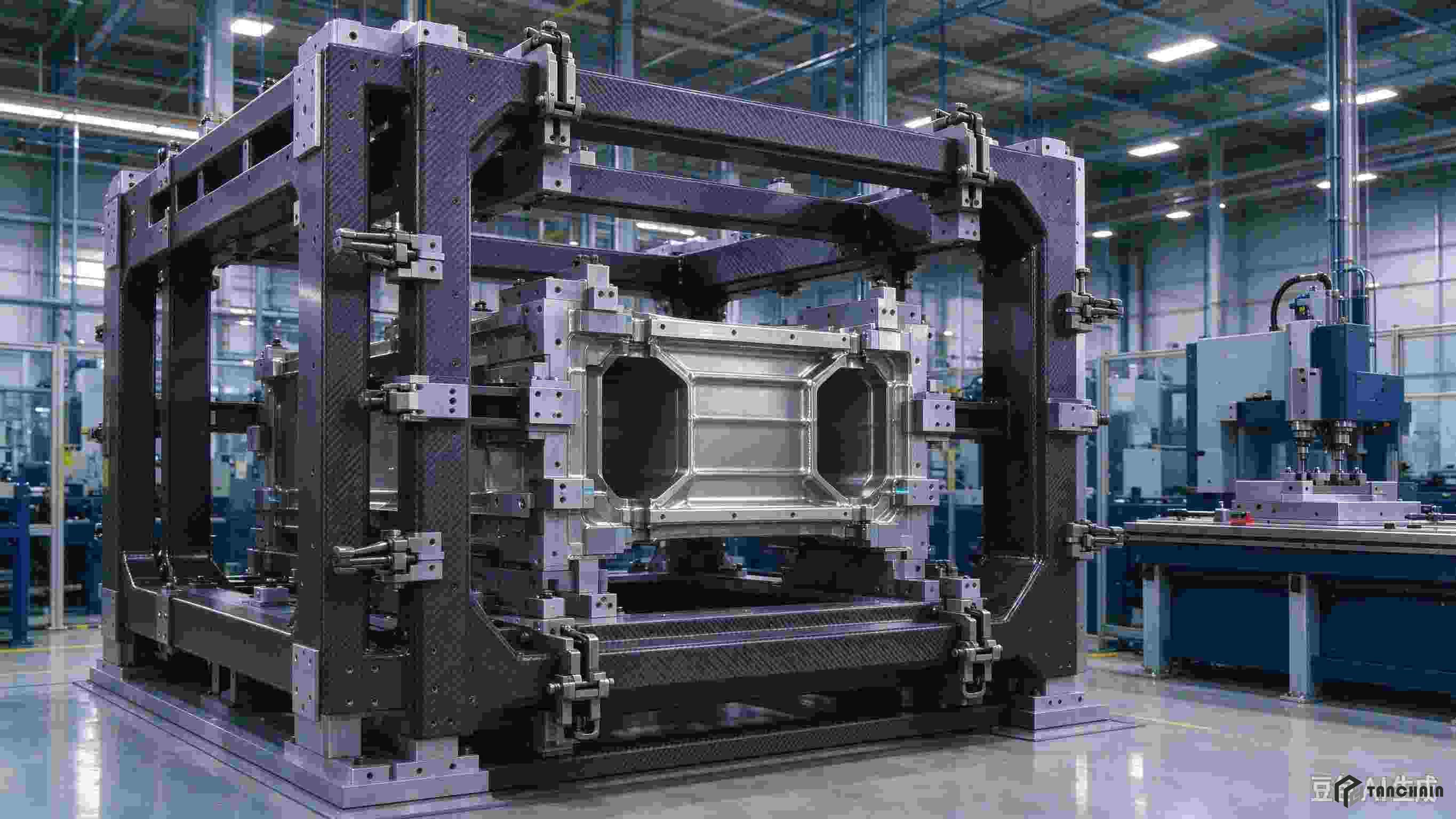
Assembly jigs hold two or more components in a fixed relationship during drilling, riveting, welding or bonding. Their job is to preserve hole positions and gap tolerances across a shift. Pultruded carbon fiber profiles give a jig the stiffness of a much larger steel section at a fraction of the mass, while machined carbon fiber plate provides local pads where locators and clamps are mounted.
2.3 Checking Fixtures and Gauges
Checking fixtures measure a part rather than hold it, so their frames should be as close to thermally inert as possible. Carbon fiber plate frames with bonded or bolted inserts are common in automotive body-in-white checking, where one fixture may verify dozens of features on a single panel.
2.4 Welding and Fabrication Fixtures
Fixtures used near welding arcs face heat, spatter and the risk of an accidental strike. Carbon fiber conducts but will not survive a direct arc. The workable approach is a carbon fiber frame with steel or copper wear surfaces at the contact points, so the structure stays light while the working faces stay suitable for the process.
2.5 Test Rigs and Load Frames
Structural test rigs benefit from stiffness, damping and low mass. A lighter frame has less inertia, which shortens settling time between load steps and makes high-cycle fatigue testing more economical. Carbon fiber tubes and plates also suit vibration test fixtures, where their damping reduces the resonance amplification that can invalidate a test.
| Tooling type | Dominant requirement | Typical carbon fiber form |
|---|---|---|
| Layup mould and mandrel | Low thermal expansion, surface quality | Tooling prepreg, fabric, plate |
| Assembly jig | Stiffness, repeatability, low mass | Pultruded profiles, tubes, machined plate |
| Checking fixture | Dimensional stability | Carbon fiber plate with bonded inserts |
| Welding fixture | Heat tolerance at contact points | CFRP frame with metal wear faces |
| Test rig | Damping, low inertia | Tubes, plates, sandwich panels |
3. The Material Forms and What Each One Does
Carbon fiber is a family of semi-finished products, not a single material. Specifying the right form is the difference between a fixture that works and one that is expensive to build.
3.1 Tow and Roving for Winding and Pultrusion
Tow is the raw reinforcement used by the processor who builds the tube or profile. A tooling fabricator buying pultruded stock does not specify tow directly, but understanding it explains why pultruded sections carry most of their stiffness along the axis and very little across it.
3.2 Fabric and Prepreg for Moulds and Panels
Woven fabric gives a mould a balanced surface and predictable drape. Prepreg adds the resin system and the controlled fibre volume fraction that a dimensionally critical mould requires. For large checking fixture panels, a plate made from fabric or spread-tow prepreg offers a stable, machinable sheet with a uniform coefficient of expansion.
3.3 Pultruded Profiles for Frame Structures
Square, rectangular, round and custom pultrusions form the bones of most tooling frames. They arrive in long lengths, are cut to size and joined with bonded gussets or mechanical fittings. Because a pultruded beam is efficient in one direction, frames are usually designed so that bending happens along the strongest axis.
3.4 Carbon Fiber Plate for Locator Pads and Gauge Faces
Plate is used wherever a fixture needs a flat, stable surface with holes, slots and inserts. It machines cleanly with carbide tooling, accepts threaded inserts and bonds to pultruded frames. Typical thicknesses run from a few millimetres for gauge faces to twenty or more for load-bearing brackets.
3.5 Tubes for Rollers, Mandrels and Frame Diagonals
Roll-wrapped tubes provide a round section with high torsional stiffness, useful for roller shafts in handling equipment, mandrels for composite winding and diagonal bracing in larger jigs. Where a frame must resist twisting rather than bending, a tubular diagonal is often the cheapest way to add that stiffness.
4. What Carbon Fiber Actually Improves on the Floor
Composite tooling is not a universal upgrade. It pays where one of the following effects matters and costs more than steel where none of them do.
4.1 Dimensional Repeatability Across a Shift
A fixture with a low expansion coefficient holds its dimensions as the shop warms and cools. For checking fixtures and precision assembly jigs this removes a source of variation no operator skill can control, and it allows tighter tolerances without moving the station into a temperature-controlled room.
4.2 Faster Handling and Changeover
Light fixtures move with one person or a small lifter, which removes the need to schedule a crane for routine changeovers. In a cell running several product variants, that changeover time is often the hidden constraint on output.
4.3 Less Inertia in Automated Cells
When a robot carries a fixture, the payload budget is shared between tool and part. A lighter fixture leaves more payload for the work piece, allows higher acceleration within the same torque limits and reduces wear on the joints. The same reasoning applies to rotary tables and linear actuators.
4.4 Damping and Cleanliness
Carbon fiber laminate dissipates vibration more effectively than steel, which shortens settling time after a move and reduces chatter in machining fixtures. It also produces no corrosion products, so a fixture in a clean assembly area does not shed rust onto the part or the floor.
4.5 Where Steel Still Wins
High-impact environments, direct weld contact and fixtures that must absorb large crushing loads remain better served by steel. Carbon fiber is strong but brittle under point impact, and a deep gouge in a structural frame is difficult to assess. Sound tooling design uses composites for the structure and metals for the wear surfaces.
5. A Short Application Walk-Through: Automotive Checking Fixture
Consider a tier-one supplier that must verify a large body panel with forty measurement features. The panel tolerance is tight, the checking station shares a hall with stamping presses, and the hall temperature varies through the day.
The frame is built from pultruded carbon fiber profiles with bonded gussets, giving a structure one operator can reposition. The gauge face is a carbon fiber plate machined with the locator pattern and fitted with bonded steel inserts at points that see repeated clamping wear. Elastomer pads are bonded where the panel rests, and a thin aramid fabric skin is laminated into the surface where the operator leans, improving impact resistance.
The result is a fixture weighing roughly a third of the welded steel equivalent, holding dimensions between morning and afternoon, and movable without a crane. The trade-off is higher material and machining cost up front, offset by lower installation effort and fewer measurement disputes later.
6. Design and Build Notes That Prevent Rework
Most carbon fiber tooling problems trace back to a handful of decisions made before a single part is cut.
6.1 Design for the Anisotropy
Pultruded profiles are much stronger along the axis than across it. A frame designed as if the material were isotropic will produce local failures at joints and load points. Treat the profile as a beam with a preferred bending direction and orient it accordingly.
6.2 Joints Need Thought
Bonded joints distribute load well but need proper surface preparation and a controlled bond line. Bolted joints need washers or inserts to spread bearing stress, and holes must be drilled with backing support to avoid delamination at breakout. Combining both, with adhesive carrying shear and bolts carrying peel, is usually the most robust approach.
6.3 Isolate the Interfaces
Where carbon fiber meets aluminum or steel, galvanic corrosion is a real risk in the presence of moisture. Isolation sleeves, washers, or a glass or aramid fiber barrier layer at the interface are simple, standard precautions.
6.4 Keep the Grounding Plan Explicit
Carbon fiber conducts electricity. A fixture in a cell with power tools and dust extraction needs an identified grounding path, and the design should state where it is rather than leaving the decision to the electrician at commissioning. Aramid and pre-oxidized fiber parts can serve as insulating separators where isolation is required.
6.5 Budget Machining and Inspection
Carbon fiber plate machines well but generates dust that requires extraction, and it wears tooling faster than aluminum. A business case that ignores machining cost will be surprised at the total. The same applies to inspection: internal voids and delamination in a bonded composite assembly are better found by ultrasonic or radiographic checks than by visual inspection.
7. Supporting Fibers Around the Carbon Structure
Carbon fiber rarely works alone in a tooling project. Two other high-performance fibers routinely appear alongside it.
Aramid fiber provides impact and abrasion resistance where a fixture is likely to be struck, dragged or clamped repeatedly. Aramid fabric can be laminated into the outer plies of a panel or used as a sleeve at contact points. Aramid is also an electrical insulator, which helps where isolation is required at metal interfaces.
Pre-oxidized fiber handles thermal and flame protection: barrier fabrics, insulation pads and protective curtains around welding and heating stations. In a fabrication cell, pre-oxidized fiber felt and fabric keep heat away from the composite structure, so the lightweight frame can work close to a hot process.
8. Cost Reality and Where the Savings Come From
Carbon fiber tooling usually costs more to buy and less to own. The purchase price reflects raw material cost, machining time and the engineering effort of a less familiar design. The ownership cost falls through handling time, changeover time, measurement stability and reduced maintenance.
For low-volume static fixtures that never move and sit in a temperature-controlled room, steel or aluminum is often the correct choice. For high-mix cells, large frames, moving fixtures and any tooling that affects measurement, the composite case is usually strong. The decision is best made per fixture rather than as a plant-wide policy.
9. Material Package for Tooling and Fixture Builders
Shanghai Tanchain supplies the fiber products a tooling shop needs, from raw reinforcement to finished cut stock.
Carbon fiber tow and roving for pultrusion, winding and braiding of frame sections.
Carbon fiber fabric and prepreg for moulds, gauge faces and structural laminates.
Carbon fiber plate for locator pads, gauge surfaces and machined brackets.
Pultruded carbon fiber profiles in square, rectangular and round sections for frame structures.
Carbon fiber tubes for rollers, mandrels and diagonal bracing.
Aramid fabric, yarn and short fiber for impact skins and electrical isolation.
Pre-oxidized fiber felt, fabric and yarn for heat barriers around welding and curing stations.
Material can be supplied for in-house fabrication or as machined parts to drawing, which lets a tooling department choose between keeping the work internal and outsourcing the cutting step.
10. Conclusion: Light, Stable and Repeatable Tooling
The case for carbon fiber in tooling is not that it is stronger than steel. It is that a fixture must be light enough to handle, stable enough to measure from and stiff enough to hold position all day, and composites meet those three requirements at a lower mass than any metal. As production moves toward higher product mix and tighter tolerances, the cost of a heavy, drifting fixture becomes more visible on the shop floor.
Start with the fixture that hurts most: the one that needs a crane, the one that drifts during a shift, or the one that slows a robot cell. Send us the load case, the working envelope and the process conditions, and we will suggest the carbon fiber forms that fit. Browse our carbon fiber and high-performance fiber products or contact us for a quotation on your tooling and fixture materials.