


-
Carbon Fibre Applications in the Textile Manufacturing Industry
-
How carbon fibre composites improve spinning, weaving, knitting, finishing and automation equipment in textile manufacturing, from spindles and rollers to heddle frames and flame-retardant insulation.
Why the Textile Manufacturing Industry Turns to Carbon Fibre
Modern textile manufacturing is a high-speed, high-vibration, high-precision business. Spinning frames run at tens of thousands of revolutions per minute, warp knitting machines cycle faster than the eye can follow, and every extra kilogram of moving mass costs energy, accuracy and bearing life. This is exactly the environment where carbon fibre reinforced polymer (CFRP) earns its place. Carbon fibre composites deliver the stiffness of steel at roughly a quarter of the weight, with near-zero thermal expansion and excellent fatigue and damping behaviour, making them a natural fit for spinning, weaving, knitting, finishing and material-handling equipment.
At Tanchain we supply the full upstream material range that textile machinery builders and mill maintenance teams need: carbon fibre filament and chopped fibre, woven carbon fibre fabric, carbon fibre prepreg, plus finished carbon fibre tubes, boards and machined parts. Alongside these we offer aramid filament and aramid fabric for wear and cut protection, and pre-oxidized fibre yarn, fabric and felt for heat and flame protection on hot-running lines. This article maps how carbon fibre composites are used across the textile industry, component by component.
High-Speed Spindles, Rotors and Twisting Elements
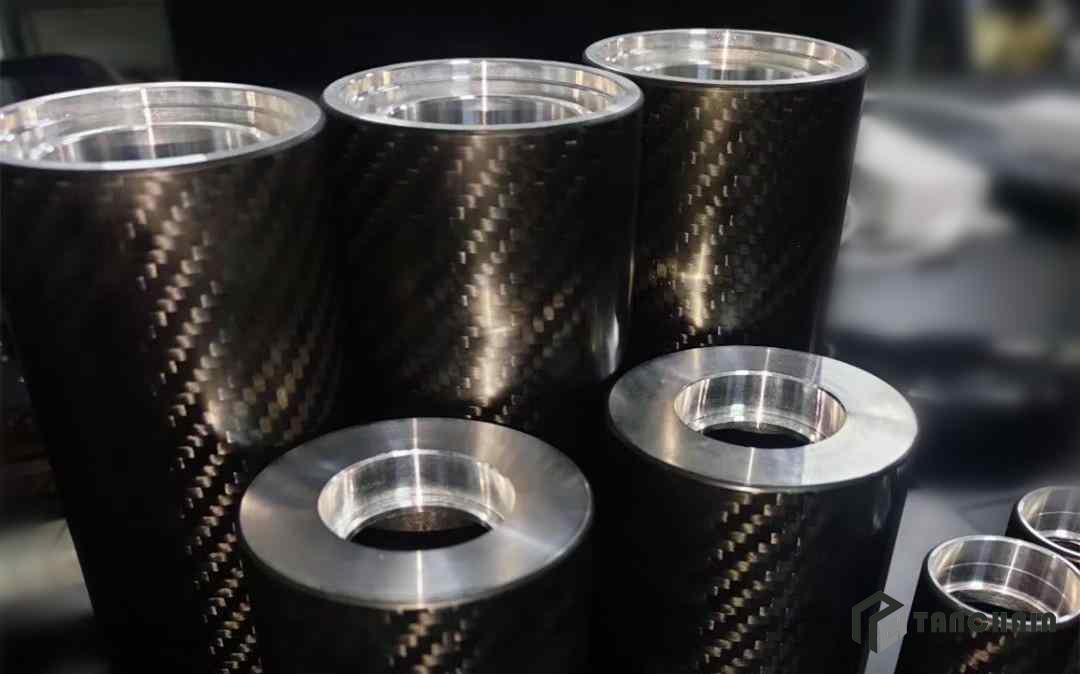
The single biggest win for carbon fibre in textiles is rotational mass. A spinning or twisting spindle that spins at 30,000 rpm and above carries enormous centrifugal load; reducing its mass reduces energy draw, vibration and bearing wear at the same time. Carbon fibre filament wound tubes replace steel and aluminium spindle shafts, and carbon fibre tube assemblies are used for the long, slender rotors that must stay straight at speed.
Carbon fibre prepreg laminates allow the winding angle to be tuned so stiffness runs in the load direction while torsional compliance stays predictable. Because CFRP also damps vibration far better than metal, yarn breakage from resonance drop sharply, which directly improves yield and machine uptime.
Beams, Gantries and Moving Frames
Warp knitting machines, warp beams, and modern high-speed looms all rely on long, rigid, lightweight beams and gantries. When a warp beam or an oscillating frame is lighter, it can accelerate and reverse direction faster, and the machine can run at higher rate without shaking the floor. Carbon fibre tubes and carbon fibre boards are used for beam cores, reed holders, batten frames and gantry rails.
The low coefficient of thermal expansion of CFRP matters here too: as a mill warms up through a shift, metal beams grow and the sheet geometry drifts, while carbon fibre beams stay dimensionally stable. Carbon fibre fabric laid up with resin provides the surface finish and stiffness, and carbon fibre prepreg is chosen where the highest stiffness-to-weight ratio is required.
Rollers, Guides and Yarn Contact Components
Rollers, godets and guide elements carry yarn at high speed over long distances. Traditional steel rollers are heavy and prone to corrosion from sizing agents, dyes and humid finishing rooms. Carbon fibre tube rollers are light enough to reduce drive torque, stiff enough to resist sag across wide machines, and chemically inert to most process fluids. Their low inertia means faster ramp-up and stop, tighter tension control, and less slippage on the yarn.
Where yarn abrasion is aggressive, aramid fabric and aramid filament are used as protective cover layers, since aramid offers outstanding cut and abrasion resistance. Pre-oxidized fibre fabric can be applied where a roller or guide sits in a hot zone and needs flame-retardant protection.
Weaving Frames, Needle Bars and Dobby Mechanisms
In weaving, the reciprocal motion of the heddle frames, needle bars and dobby mechanism is limited by the mass of the moving parts. Carbon fibre boards and carbon fibre tube profiles allow these elements to be built lighter and stiffer, so the shed opens and closes faster with less overshoot. The result is higher picks per minute, less yarn stress, and lower noise level on the weaving floor.
Carbon fibre composites also resist the fatigue that eventually cracks metal heddle frames after hundreds of millions of cycles. Components made from carbon fibre fabric laminates can be repaired or re-laminated rather than replaced, an important cost consideration for large mills.
Knitting, Warping and Texturing Machinery
Warp knitting and texturing machines combine very fast motion with very tight tolerance. Carbon fibre tubes are used for guide bars, pattern beams and creel arms, where stiffness and low inertia prevent pattern drift. In false-twist texturing, carbon fibre composite spindles and discs handle high speed with lower friction and longer service life.
For transfer and take-up systems on warpers and winders, carbon fibre boards form lightweight traversing carriages. Because CFRP dampens vibration, the yarn winding pattern stays uniform, which improves package density and downstream unwinding performance.
Finishing, Dyeing and Heat-Processing Lines
Finishing and dyeing lines are hot, humid and chemically aggressive — the worst possible environment for unprotected metal. Here carbon fibre composites are used for tenter frame rails, stenter clips carriers, guide rails and lightweight tensioning arms. Carbon fibre tube structures resist corrosion from steam, dye liquors and finishing chemicals far better than steel, and they hold their length as temperature swings.
Where lines run at elevated temperature, pre-oxidized fibre felt and pre-oxidized fibre fabric serve as insulation blankets, heat shields and flame-retardant barriers. These materials are non-combustible in normal service and protect both the structure and the operators, making them a standard choice for furnace, dryer and heat-set zones in textile plants.
Material Handling, Creels and Automation Modules
Modern mills automate yarn transport, package handling and roll movement with robots, gantries and overhead conveyors. Every kilogram of moving mass in these systems is paid for in motor size, energy and cycle time. Carbon fibre tubes and carbon fibre boards are widely used for robot arms, end-effectors, gripper beams and creel structures, cutting inertia so the axis can accelerate faster and settle more accurately.
Carbon fibre chopped fibre reinforced compounds are also used for brackets, covers and enclosures to reduce weight and part count. Together these components let mill automation run at higher throughput with lower energy cost per kilogram of yarn produced.
Flame Retardance and Thermal Insulation on the Line
Textile plants often sit next to hot processes, and fire safety is a constant concern. Pre-oxidized fibre is inherently flame retardant and does not melt or drip, so pre-oxidized fibre yarn, fabric and felt are used for fire barriers, protective curtains, duct lagging and equipment blankets. Aramid fabric adds strength and cut resistance to the same protective assemblies, and blended aramid/pre-oxidized constructions are common in firefighting and industrial protective clothing — a related market that shares the same material base.
For thermal insulation, pre-oxidized fibre felt is used around dryers, heat-setting ovens and steam lines. It retains its structure at high temperature and provides reliable insulation without the health and handling drawbacks of some traditional fibrous insulants.
Material Forms Supplied for Textile Applications
Different components call for different material forms, and choosing the right one early keeps cost and lead time under control.
Carbon fibre filament and tow — the base for winding spindles, rollers and composite tubes; available in standard and high modulus grades.
Carbon fibre woven fabric — 3K and 12K weaves for laminated beams, guide bars and surfacing layers.
Carbon fibre prepreg — resin pre-impregnated fabric and unidirectional tape for the highest stiffness-to-weight structural parts.
Carbon fibre tube — pultruded and roll-wrapped tubes for rollers, gantries, creels and robot arms.
Carbon fibre board — flat laminate sheet for heddle frames, carriages and machine covers.
Carbon fibre chopped fibre — reinforced compounds for brackets, housings and small precision parts.
Aramid filament and aramid fabric — cut, abrasion and impact protection for yarn contact and protective assemblies.
Pre-oxidized fibre yarn, fabric and felt — flame retardant and thermal insulation for hot zones and fire barriers.
Specification and Sourcing Considerations
When specifying carbon fibre for textile machinery, several practical points decide whether the part performs as expected. First, define the load direction and stiffness target, because carbon fibre is strongest along the fibre axis and the laminate lay-up must match the real stress path. Second, consider the chemical environment: most CFRP handles sizing agents, dyes and humidity well, but the resin system must be chosen for the specific process fluids and temperatures. Third, think about joints and interfaces, since bolted or bonded connections to metal need proper isolation to avoid galvanic corrosion.
Fourth, match the manufacturing route to the quantity and geometry: pultruded carbon fibre tube is cost-effective for constant cross-sections, roll-wrapped tube for higher performance, and carbon fibre board laminate for flat parts. Finally, plan the fire and thermal protection layer at the same time as the structure, using pre-oxidized fibre or aramid materials where codes or safety practice require it. Sourcing all of these from a single qualified supplier shortens qualification time and keeps material consistency across a machine platform.
Trends Shaping Carbon Fibre Use in Textiles
Three trends are pushing carbon fibre deeper into textile manufacturing. The first is speed: competitive mills keep raising machine rates, and lighter moving parts are the clearest path to more throughput without more vibration. The second is energy cost: with electricity and gas prices high, the lower inertia and lower drive load of CFRP components translate directly into operating savings. The third is automation and digital control: as mills add sensors, servo axes and robotics, the high stiffness, damping and dimensional stability of carbon fibre composites make them the preferred structural material for accurate, repeatable motion.
Sustainability is also entering the picture. Because carbon fibre parts resist fatigue and corrosion, they last longer and generate less replacement waste than the metal components they replace, and the related pre-oxidized and aramid protective materials help mills meet fire-safety and insulation requirements with durable, non-deteriorating products.
Conclusion
Carbon fibre composites have moved from a specialty curiosity to a mainstream engineering material in textile manufacturing. They raise spindle and beam speed, cut vibration and energy use, resist corrosion in finishing rooms, and give automation the light, stiff structures it needs. From carbon fibre tube rollers and carbon fibre board heddle frames to carbon fibre prepreg structural beams, and from aramid fabric wear protection to pre-oxidized fibre flame barriers, the material toolkit covers the whole production line.
Tanchain supplies carbon fibre filament, carbon fibre chopped fibre, carbon fibre woven fabric, carbon fibre prepreg, carbon fibre tube, carbon fibre board and machined carbon fibre parts, together with aramid filament, aramid fabric, and pre-oxidized fibre yarn, fabric and felt. To explore how these materials can improve your textile machinery or line, browse our product range or contact us for a quotation and technical guidance.