


-
Carbon Fiber for Solar Trackers and Photovoltaic Mounting Structures
-
How carbon fiber composites make solar tracker torque tubes, purlins and module rails lighter and stiffer, cutting pile count, foundation cost and site labor in utility-scale photovoltaic plants.
Carbon Fiber for Solar Trackers and Photovoltaic Mounting Structures
Utility-scale solar is no longer a niche generator. It is one of the cheapest sources of electricity in the world, and the projects behind that cost curve are enormous: single-axis tracker rows that run for kilometres, modules mounted a few metres above ground, and structures expected to survive twenty-five years of wind, hail, thermal cycling, and soil movement. The economics of a solar farm are decided by two numbers: how much energy each module produces, and how much steel, concrete, and labour the mounting structure consumes per megawatt. Carbon fiber composite materials are now moving into that second number, and the effect on project economics is measurable.
This guide explains where carbon fiber and high-performance fiber composites belong in solar tracking and photovoltaic mounting systems, why the structural logic differs from a wind turbine blade or a bridge, how a tracker supplier should evaluate the material, and what has to be true in manufacturing and installation before a composite structure outperforms the galvanised steel it replaces.
1. Why Solar Mounting Structures Are a Material Problem
A photovoltaic module converts light into electricity, but it does nothing to support itself. The mounting structure carries every wind load, keeps the modules at the correct tilt and azimuth, and holds the array rigid enough that the sun's position and the module's position agree. That structure is typically 20 to 40 percent of the mechanical bill of materials in a tracker-based plant.
The structural challenge is unusual. Solar structures span long distances with very few supports, they are slender and lightly loaded compared to their length, and their dominant failure mode is not collapse but deflection combined with fatigue from wind buffeting and tracker rotation. That combination rewards a material with high specific stiffness and good damping far more than one with high absolute strength.
Low density: a lighter torque tube reduces the load on the bearing housings, the piles, and the foundation, with savings that multiply down the load path.
High specific stiffness: the same tracker row can span further between piles without unacceptable sag or torsional rotation.
Corrosion resistance: no hot-dip galvanising, no coating repair after site damage, and no rust at the cut edges of a drilled hole.
Fatigue tolerance: carbon fiber laminates endure millions of low-amplitude load cycles from wind and daily tracker motion.
Thermal stability: low expansion keeps module alignment stable through the day and through the seasons.
None of these properties is unique to carbon fiber in isolation. The reason the material is interesting is that a tracker needs all of them at once, at the lowest possible mass.
2. Where Carbon Fiber Fits in a Tracker
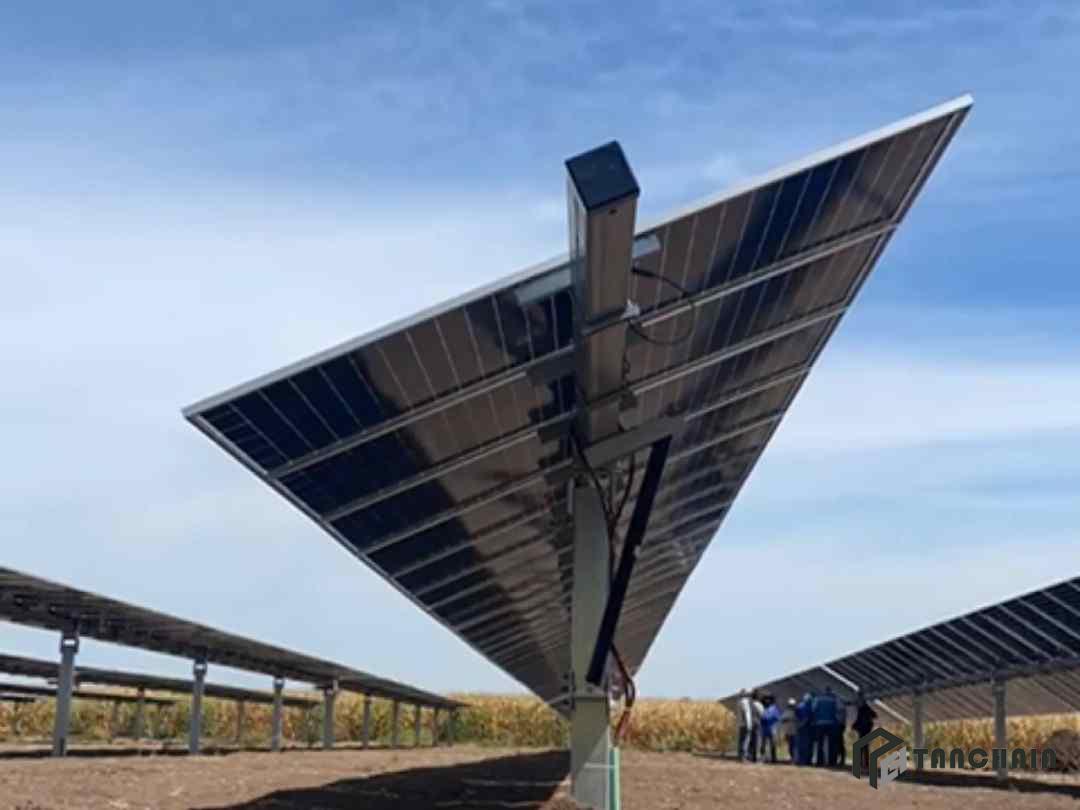
Single-axis trackers, which dominate utility-scale solar, share a common architecture: a row of piles or posts, a torque tube running along the row, bearing housings that let the tube rotate, module purlins and clamps that attach the panels, and a drive unit at one end or the centre of the row. Carbon fiber composites can be used at several of those points, and the value of each application is different.
2.1 The Torque Tube and the Span Between Supports
The torque tube is the primary structural element and the place where carbon fiber delivers the clearest benefit. Steel torque tubes are limited by their own weight: as the span between piles grows, the tube must resist both bending from wind load and torsion from the drive, and a heavier tube demands heavier bearings and a stronger foundation.
A pultruded carbon fiber tube or a filament-wound carbon fiber tube offers a much higher stiffness-to-weight ratio, so the design can either span further between pile rows or use a thinner wall at the same span. Fewer piles translate directly into less site civil work, which is often the largest single cost component in tracker installation. This is the same logic that made pultruded carbon fiber profiles a standard product in other infrastructure sectors.
2.2 Module Purlins and Rails
Purlins carry the module load to the torque tube and set the plane of the array. They are numerous and repetitive, so material cost matters even more than in the tube itself. A carbon fiber box profile or a composite rail replaces a heavier steel section and reduces the dead load that the torque tube and bearings must carry, which compounds the savings upstream.
Because composite rails can be pultruded in continuous lengths, they also reduce the number of splice joints in a row. Every joint is a potential fatigue initiation point and a field labour cost, so fewer joints is a structural and a commercial win at the same time.
2.3 Bearings, Clamps, and Connection Hardware
Carbon fiber does not eliminate fasteners, but it changes them. Bearing housings can be built from a composite body with a metal or polymer insert at the wear surface, reducing mass without sacrificing the bearing interface. Module clamps machined from carbon fiber plate are light, dimensionally stable, and immune to galvanic corrosion against aluminium frames.
Where composite parts meet metal fasteners, the design must manage galvanic corrosion and bearing stress carefully. A supplier who understands composite-to-metal joints, and can supply insulating washers and compatible inserts, removes a common source of field failures.
2.4 Drive System Components and Dampers
Tracker drives see a load spectrum that includes slow daily rotation, wind gusts, and the sudden stops that follow a stow command. Carbon fiber shafts and torque-transfer components reduce rotational inertia, which lowers the peak torque the drive must supply. Aramid fabric and pre-oxidized fiber components appear in the same systems as protective and insulating elements, and composite dampers help control the torsional vibration that can otherwise amplify at long row lengths.
3. The Engineering Case: Stiffness, Torsion, and Wind
Solar structures are designed against wind first. A tracker row is a very long, very slender beam with a large sail area, and the governing load is usually an uplift or a lateral gust rather than the static weight of the modules. The design must limit deflection so that the modules do not collide with each other in the stow position and so that the drive does not bind.
3.1 Deflection Rather Than Strength Sets the Section
Because the allowable stress in a lightly loaded, long-span member is rarely reached before the deflection limit, the controlling material property is stiffness per unit mass, not strength per unit mass. This is why high-modulus carbon fiber can win where a high-strength steel cannot: the design is stiffness-driven, and stiffness is exactly where CFRP leads.
3.2 Torsion and the Rotation of a Long Row
A tracker row has to rotate as one body, or the modules along the row will point in different directions and the row will produce less power than the energy model assumed. Torsional stiffness therefore has a direct revenue consequence. A carbon fiber tube with a large diameter and a thin wall gives very high torsional stiffness per kilogram, letting a single drive control a longer row without excessive twist.
3.3 Fatigue from Wind and Daily Motion
Even a calm site loads a tracker every day, because rotation itself is a load cycle. Carbon fiber laminates are well suited to this regime, provided the layup is correct and the laminate is not loaded in a way that damages the fiber architecture. Design against fatigue means watching the bond lines and the fastener holes as much as the laminate itself.
4. Composite Material Forms for Solar Structures
A tracker programme consumes several fiber forms, and matching the form to the part is what keeps weight and cost in balance.
Pultruded carbon fiber profiles and tubes: constant cross-section torque tubes, purlins, and structural rails produced in continuous lengths.
Filament-wound carbon fiber tubes: torsionally critical tubes where the winding angle is tuned for torque rather than bending.
Carbon fiber fabric and multiaxial cloth: laminating local reinforcements, bearing areas, and repair sections.
Carbon fiber prepreg: press or autoclave cured brackets and drive components where the fiber volume and cure are tightly controlled.
Carbon fiber plates and machined parts: clamps, brackets, spacers, and inserts cut to tolerance.
Aramid fabric and staple fibre: impact-tolerant and electrically insulating elements in drive and junction hardware.
Pre-oxidized fiber yarn, felt, and fabric: thermal and fire barriers at electrical enclosures and cable routing.
The same fiber architecture logic used in other outdoor infrastructure - unidirectional tow where bending dominates and woven or multiaxial fabric where shear and impact resistance matter - applies directly here.
5. Durability in the Field
A solar farm is an outdoor structure with a twenty-five year design life and almost no maintenance budget. Durability is therefore a first-order requirement, not a nice-to-have.
5.1 UV, Moisture, and Thermal Cycling
Carbon fiber itself is unaffected by ultraviolet light, but the resin matrix is not. A properly formulated gelcoat or a UV-stable resin system protects the laminate, and a supplier who tests for it will specify the protection rather than assume it. Moisture uptake in the matrix, and freeze-thaw cycling in cold climates, are managed by correct resin selection and by keeping the laminate free of voids and dry fiber.
5.2 Galvanic Corrosion at Metal Interfaces
Carbon fiber is electrically conductive and, in contact with a metal in the presence of moisture, it acts as a cathode and accelerates corrosion of the metal. Every composite-to-metal joint in a solar structure needs an insulating layer, a compatible fastener, or a deliberately isolating insert. This is a design detail that decides whether a composite structure lasts or fails at the bolted connection, and it is the single most common oversight in a first composite tracker design.
5.3 Impact, Hail, and Site Handling
Modules arrive on site and are installed by crews working quickly. Composite structures must tolerate the knocks and dropped tools of installation as well as the hail and debris of service. Impact tolerance is a function of the fiber architecture and the resin toughness, which is why aramid and hybrid layups appear where handling damage is a risk.
6. Manufacturing, Logistics, and Installation
Composite structures solve a site logistics problem as well as a structural one. Pultruded and wound profiles are light enough that more material fits on a truck, and light enough that a small crew can position a section by hand without a crane. On a remote or mountainous solar site, that reduction in handling equipment can matter more than the material cost difference.
The factory side matters too. Continuous pultrusion and filament winding produce consistent sections at a known fiber volume and a controlled cure, and that consistency is what allows an engineer to predict a tracker's behaviour in the field. Quality control on void content, fiber alignment, and bond-line integrity is what converts a material specification into a reliable product.
7. A Sourcing Checklist for Solar Structure Suppliers
Buyers specifying composite members for a tracker or fixed-tilt structure should confirm the following with the supplier before committing to volume.
Fiber type and modulus, since the stiffness-driven design is highly sensitive to it.
Manufacturing route, whether pultruded, wound, or laminated, and the resulting fiber volume fraction.
Resin system and UV protection, matched to the site's climate and expected service temperature.
Tolerance on straightness, twist, and hole position, because a tracker row multiplies every small error along its length.
Traceability and batch consistency, so a replacement section matches the structure it joins.
Galvanic isolation guidance and compatible fastening hardware.
A supplier who can discuss the structural demand of a tracker, not just the material datasheet, will typically save the buyer a design iteration and a field retrofit.
8. Where Solar Structures Are Heading
The trend in utility solar is toward longer rows, taller structures for bifacial and agrivoltaic designs, and floating and offshore photovoltaic systems where mass and corrosion resistance are even more critical. Each of these trends pushes the structure further into the territory where a high specific stiffness material wins. As module costs continue to fall, the mounting structure becomes a larger share of the balance of system, and the incentive to optimise it grows.
The likely outcome is a hybrid structure: steel or aluminium at the foundation and the drive, carbon fiber composites in the long spans and repetitive members where mass savings compound most. Engineers who understand both the composite and the solar application will be the ones who capture that value.
Partnering with Tanchain for Solar Composite Solutions
Shanghai Tanchain New Material Technology supplies carbon fiber filament and tow, carbon fiber fabric in unidirectional, woven, and multiaxial constructions, carbon fiber prepreg, pultruded carbon fiber profiles and tubes, and machined carbon fiber plates and components for solar tracker and photovoltaic mounting programmes. Alongside the carbon range we supply aramid filament, aramid staple fibre and aramid fabrics, and pre-oxidized fiber in yarn, felt, fabric and staple form for thermal, fire, and electrical protection duties.
Whether the requirement is a stiff, corrosion-free carbon fiber torque tube for a long tracker row, a pultruded purlin section for a fixed-tilt array, or a machined carbon fiber clamp for a module frame, our team can review the structural demand and recommend the right fiber, resin, and architecture. To explore the full range of carbon fiber and high-performance fiber products for the solar and renewable energy industry, visit our product pages or send your drawing and load requirements for a quotation.