


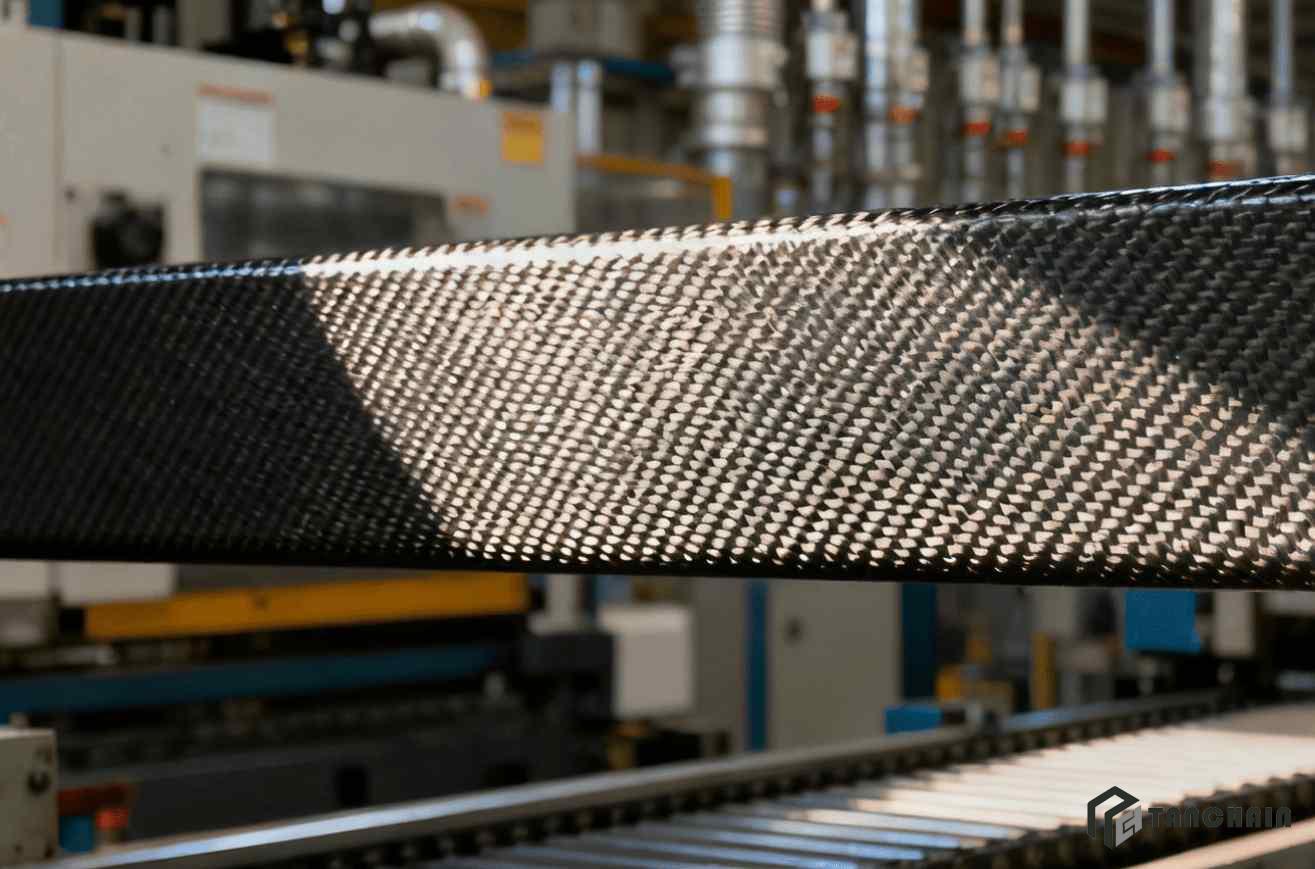
-
Carbon Fiber in Precision Machine Tools: Stiffness, Damping and Thermal Stability
-
How carbon fiber composites are used in precision machine tools - moving gantry beams, spindles, beds, robot arms, metrology frames and boring bars - and why stiffness, damping and near-zero thermal expansion drive the switch to CFRP.
Precision machine tools live or die by stiffness, damping and thermal stability. A machining centre that deflects a few micrometres under cutting load, or drifts when the spindle warms up, cannot hold the tolerances that modern aerospace, automotive and electronics work demands. For decades the answer was cast iron and welded steel, but both materials bring their own penalties: weight that limits acceleration, damping that is only mediocre, and thermal expansion that grows with every degree of shop-floor temperature change. Carbon fibre composites have steadily moved into this space, and this article maps where carbon fibre reinforced polymer (CFRP) is used across the machine tool industry, why it works, and what buyers should consider.
Why the Machine Tool Industry Turns to Carbon Fibre
Machine tool builders need three things at once: high stiffness, high damping and low thermal expansion. Steel and cast iron deliver stiffness but are heavy and expand noticeably with heat. Aluminium is light but has a high coefficient of thermal expansion, which is fatal for a structure that must hold micron-level accuracy over a long shift.
Carbon fibre reinforced polymer offers a specific stiffness several times that of steel and cast iron, so a moving axis can be both stiffer and lighter. The fibre-reinforced lay-up also damps vibration far better than a homogeneous metal, which raises cutting stability and improves surface finish. Critically, CFRP can be engineered to a near-zero coefficient of thermal expansion by balancing fibre orientation, so the structure grows and shrinks far less as the shop warms and cools.
Together these properties address the core pain points of the machine tool industry: deflection under load, chatter during cutting, and thermal drift during long unattended runs.
Moving Columns, Cross Beams and Gantries
The most established use of carbon fibre in machine tools is the moving structure. On a gantry machining centre the cross beam carries the spindle head and must resist bending and torsion without sagging under its own mass. A carbon fibre composite beam or column weighs a fraction of the steel equivalent while resisting deflection more effectively, so the builder can raise axis acceleration and reduce the motor and drive size needed to move the axis.
Because the mass is lower, the servo system has an easier job reversing direction at speed, and the whole machine can be built with a lighter, cheaper linear guideway and ball screw. For large bridge-type mills and router gantries, carbon fibre beams are now a routine specification where dynamic performance is a selling point.
Spindle Taper, Ram and Tooling Interfaces
Closer to the cutting edge, carbon fibre appears in spindle rams, quill extensions and tool holders where mass at the end of the arm multiplies its effect on accuracy. A lighter ram reduces the inertia the feed drive must overcome, which tightens response and shortens cycle times on contouring moves. Composite ram structures also damp the high-frequency vibration that causes chatter when a long tool reaches into a deep pocket.
Engineers must design the metal-to-composite interface carefully so that the tool and its clamping forces are transmitted without crushing the laminate, and so that any thermal mismatch with the steel spindle cartridge is managed through correct bonding and insulating details.
Bed, Base and Frame Structures
Historically the machine base was almost always a heavy iron casting, chosen as much for its mass damping as for stiffness. Carbon fibre composites change that assumption. A properly designed composite bed or frame can achieve high static stiffness while shedding weight, which helps when the machine must be shipped, installed on an upper floor or mounted on a moving platform.
Composite frames are also immune to the corrosion that attacks cast iron machines in coolant-rich environments, and they do not rust in humid or coastal workshops. Builders often combine a composite structural shell with mineral casting or epoxy granite inserts to add mass where damping is still wanted, giving a hybrid structure that outperforms a plain metal base.
Robotic Arms, Pallet Changers and Automation Modules
Modern machining cells are increasingly automated, and carbon fibre has become a natural choice for the moving elements of that automation. Articulated robot arms used for machine tending benefit from the low inertia of a carbon fibre link, which lets them accelerate faster while positioning heavy workpieces accurately.
Pallet changers, tool changers, gantry loaders and linear transfer units all move payloads repeatedly, so every kilogram saved in the moving structure translates into a smaller, faster and more energy-efficient drive. Because these modules run around the clock, the fatigue resistance and corrosion immunity of CFRP also extend maintenance intervals.
Metrology Frames and Inspection Equipment
Where a machine must measure rather than cut, dimensional stability outweighs almost every other consideration. Coordinate measuring machine (CMM) frames, optical inspection stages, laser scanner gantries and probing fixtures are frequently built from carbon fibre because the material holds its shape as temperature changes and does not sag under its own weight.
A carbon fibre metrology frame keeps the reference geometry stable during long measurement cycles, which is essential when validating parts for aerospace and medical production. The low mass also lets the measuring axis move quickly without exciting structural vibration that would corrupt the reading.
Cutting Tools, Drill Bars and Boring Bars
Vibration is the enemy of tool life and surface finish. Carbon fibre boring bars and extended tool holders resist the bending and chatter that plague long slender metal tools, allowing deeper cuts and better finish in bores and internal features. The material's high damping absorbs the energy that would otherwise feed a self-excited vibration, so machinists can push parameters that a steel bar could not sustain.
Carbon fibre is also used in tooling plates, fixture frames and vacuum tables, where its stiffness-to-weight ratio supports large, flat workholding surfaces that stay accurate while remaining light enough to handle and reposition.
Thermal Stability and Precision at the Micron Level
Thermal error is one of the largest sources of inaccuracy in precision machining, and it is a problem carbon fibre is uniquely suited to solve. By tuning the ratio of fibre directions in a laminate, designers can build a structure whose expansion in one axis offsets contraction in another, producing a composite with an engineered coefficient of thermal expansion close to zero.
This means a composite column or beam can be specified to match the thermal behaviour of the workpiece or the scale it carries, reducing the need for compensation algorithms and warm-up cycles. For grinding machines, jig borers and ultra-precision lathes, this stability directly protects the tolerance the customer is paying for.
Material Forms Used in Machine Tool Construction
Machine tool projects draw on the full range of high-performance fibre forms. Carbon fibre prepreg and dry fabric are used in hand lay-up and autoclave curing of large structural beams and frames, while carbon fibre unidirectional tape supplies the directional stiffness needed in a bending-critical member. Pultruded carbon fibre profiles provide economical constant-section tubes and rods for gantries and supports.
Carbon fibre plates and machined components serve as mounting interfaces, fixture plates and reinforcing inserts, and carbon fibre tubes are widely chosen for light structural members and rotating shafts. For thermal and electrical isolation duties, and for fire-sensitive enclosures, pre-oxidized fibre (PANOX) products in tow, yarn, fabric, felt and board form add non-combustible insulation and protection.
Design and Specification Considerations
Specifying carbon fibre for a machine tool is not simply a matter of swapping materials. The laminate must be engineered so that fibre directions follow the load paths in bending, torsion and axial compression, because the composite is strong in the fibre direction but far weaker across it. Metal inserts and bonded joints must be designed to spread load without crushing the laminate, and galvanic isolation is required wherever carbon contacts steel or aluminium hardware.
Thermal expansion should be specified as a design target rather than accepted as a fixed material property, since the lay-up can be tuned. Damping, stiffness and mass all interact, so builders often validate the design with modal analysis before cutting metal. Finally, buyers should work with a supplier who understands both composite processing and machine tool accuracy requirements, and who can document fibre content, cure schedule and mechanical test data.
Trends Shaping Carbon Fibre in Machine Tools
As manufacturers chase higher spindle speeds, faster rapids and tighter tolerances, the demand for low-inertia, thermally stable structures keeps growing. Additive manufacturing is beginning to produce hybrid metal-composite machine components, and automated fibre placement is making large composite beams more economical to produce at scale.
Sustainability is entering the picture as well. Machine tool builders and their customers increasingly ask about composite recycling and the end-of-life route for large structural parts, which favours suppliers able to support recovery and reuse. Together these forces point to a steady expansion of carbon fibre across the machine tool industry, from the bed and column to the tools and the automation that feeds them.
Conclusion
Carbon fibre composites have earned a firm place in the machine tool industry by solving the problems that metals cannot solve economically: they combine high stiffness with low weight, add damping that raises cutting stability, and can be engineered to near-zero thermal expansion for micron-level accuracy. From moving gantry beams and spindles to beds, robot arms, metrology frames and boring bars, CFRP now appears throughout the modern machine tool and its automation.
Shanghai Tanchain New Material Technology supplies carbon fibre filament and staple fibre, carbon fibre fabric, prepreg, plates and tubes, aramid filament and staple fibre, aramid fabric, and a full range of pre-oxidized fibre products including tow, yarn, fabric and felt. Explore our product range or send us your machine tool application requirements for a tailored quote.