


-
Carbon Fiber in Offshore Oil and Gas: Applications from Downhole Tubulars to Topside Structures
-
An industry application guide to carbon fiber in offshore oil and gas: downhole tubulars, subsea flowlines, risers, pressure vessels, deck structures, walkways, grating, piping, composite repair, fire and thermal protection, and how engineers choose the right material form.
A Guide to Carbon Fiber in Offshore Oil and Gas: Where Composites Earn Their Place
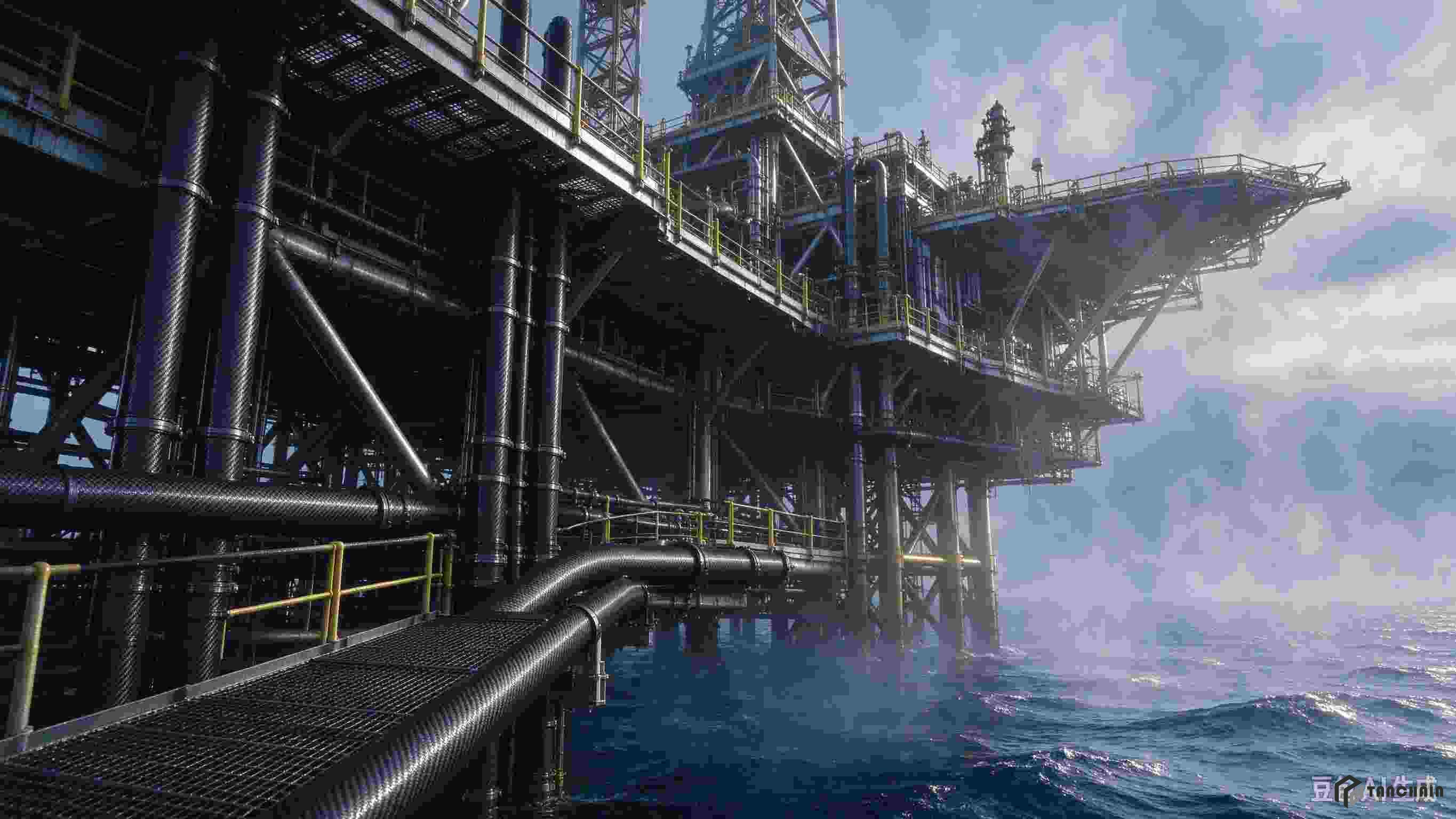
Offshore oil and gas production is one of the most expensive places on earth to install anything. A platform runs roughly fifty thousand tonnes of steel, has a service life measured in decades, and must keep producing in salt spray, wave loading, hydrogen sulphide, produced sand and a constant risk of fire. Anything added at the design stage is paid for across the whole life of the asset, not only at the purchase order.
Carbon fiber reinforced polymer has been part of that calculation for more than three decades. It first went offshore on downhole tubulars and pressure vessels, where its specific strength answered a problem that could not be solved with steel. It then moved upward, into deck structures, grating, piping, riser components and topside retrofits. This industry application guide maps where carbon fiber is actually used in offshore oil and gas: which parts of the asset it serves, which material form fits each duty, and what topside engineers and procurement teams compare before specifying composite parts on a live facility.
The article follows the asset from the reservoir upward:
Part One — Why the offshore environment resists conventional materials
Part Two — The application map: subsea, downhole, riser and topside
Part Three — Material forms and how each one is chosen
Part Four — Manufacturing, testing and qualification expectations
Part Five — The commercial case, lifecycle cost and what to verify
Part One — Why the Offshore Environment Resists Conventional Materials
An offshore installation is a materials test bench that never stops. Four load cases dominate the design of almost every component, and each one eliminates a different class of material.
1.1 Mass Is a Structural Load, Not Just a Handling Cost
On a fixed platform or a floating production unit, the topside weight budget is fixed early and fiercely protected. Every tonne of equipment added to the deck requires additional structure below it, and in a floating unit it also displaces buoyancy. That compounding effect is why a weight reduction of four hundred kilograms on a walkway module or a crane component is worth far more than the component itself. A kilogram eliminated high up in the structure saves several kilograms of hull or jacket steel below, and the saving repeats on every load case the structure is analysed for.
1.2 Corrosion Is a Continuous Operating Cost
Carbon steel in a marine atmosphere corrodes at a rate that depends on temperature, humidity, salt deposition and how effectively the coating survives. Coating repair on a platform is not a simple maintenance task: it means scaffolding, work permits, weather windows and hot-work restriction. A structure that eliminates the coating cycle altogether, because the material does not rust, removes an entire maintenance work stream rather than a single activity.
1.3 Fire and Blast Set the Life Safety Rules
Fire performance is a qualification gate, not a benefit. Equipment installed in a hydrocarbon-handling area must survive a jet fire or a hydrocarbon pool fire for a defined period, usually assessed against a recognised test protocol. Composites are not automatically suitable; they become suitable when the resin system, the reinforcement and the intumescent or insulation layers are designed and tested together for that specific duty.
1.4 Fatigue Is the Default Failure Mode
Waves impose millions of low-amplitude cycles on risers, grating supports, walkway frames and pipe spools. Steel under a corrosive environment has no true fatigue limit, because corrosion pits become crack initiators. A properly designed carbon fiber laminate is not immune to fatigue, but its damage mechanism differs: it degrades progressively in stiffness rather than failing suddenly from a single crack, which makes inspection and condition monitoring more predictable.
1.5 Where the Material Has to Fit Existing Hardware
Most offshore composite work today is retrofit, not new build. That changes the material requirement. A replacement walkway must bolt to the existing brackets, match the existing floor level and drain the existing water path. A composite repair system must be applied to a surface that has been in service and cannot be brought back to a workshop. The composite has to be tolerant of field conditions, and this is where many otherwise sound materials fail in practice.
Part Two — The Application Map from Reservoir to Deck
Carbon fiber appears in well over a dozen distinct offshore applications. They are rarely discussed together, because they sit in different engineering disciplines, but they share one logic: the material is used where its mass, corrosion resistance or fatigue behaviour changes an outcome that cannot be changed with steel.
2.1 Downhole Tubulars and Production Liners
Deepwater wells, and wells with high carbon dioxide or hydrogen sulphide content, push steel tubulars toward their corrosion allowance limits. A carbon fiber composite tubing string with a thermoplastic liner weighs roughly a quarter of the equivalent steel string, which reduces hook load, allows a smaller completion rig, and removes the corrosion allowance from the wall thickness. The material is also used for liner systems in existing wells, where a composite liner restores integrity without a full workover.
In this application, the composite is not selected purely for strength. It is selected because the string can be run into a well that the platform's completion equipment could not handle with steel, and because the liner isolates the produced fluid from the casing behind it.
2.2 Subsea Flowlines, Jumpers and Spool Pieces
Subsea composite pipe serves two roles: corrosion-resistant flowlines in fields with aggressive produced fluids, and lightweight spool pieces that reduce installation vessel load. The design constraint is usually not internal pressure alone but the combination of pressure, bending during installation and external hydrostatic load at depth. Composite pipe also has a thermal advantage: its low conductivity reduces the need for external insulation on flowlines that must avoid wax and hydrate formation during shut-in.
2.3 Risers and Riser Components
Riser systems are where the mass argument becomes decisive. A steel riser in deep water carries its own weight plus the weight of the fluid inside, and that load must be supported by the vessel or the seabed anchor. Carbon fiber composite riser joints and buoyancy modules reduce that top tension and change the fatigue loading on every component above them. Composite fairings, strakes and VIV suppression devices address a different problem: they are hydrodynamic shapes that must remain attached for years without corrosion or galling, where their light weight also reduces the load on the riser itself.
2.4 Pressure Vessels for Process and Utility Service
Topsides run on compressed air, nitrogen, carbon dioxide and other utility gases, each of which needs pressure storage. A carbon fiber wound vessel with a polymer liner, in the type III or type IV construction common in the gas storage industry, weighs a fraction of a steel shell of the same volume and pressure rating. On a platform where deck space and structural load are both restricted, this can be the difference between adding a vessel and not being able to add one at all.
2.5 Deck Structures, Walkways and Platforms
Pultruded carbon fiber profiles, plates and tube frames are used for walkway structures, equipment skids, ladders and access platforms. These are not the highest-tech items on the asset, but they produce a fast return: they do not require painting, they can be lifted by hand rather than by crane, and they can be installed under a permit-to-work without hot work. On an operating platform, the cost of installation often exceeds the cost of the material, so a structure that can be carried through a doorway and bolted into place changes the economics entirely.
2.6 Grating, Handrails and Secondary Steel
Secondary steel becomes primary cost over twenty years. Grating that rusts through, handrails that need recoating, and stair stringers that corrode at the weld toe all consume maintenance budget and inspection time. Composite grating and handrail systems, usually glass or aramid reinforced for the walking surface with carbon fiber used where stiffness is the governing criterion, remove the coating cycle and reduce the inspection burden. Carbon fiber is used selectively here, in the support beams and the long spans, where deflection rather than strength controls the design.
2.7 Piping, Ducting and Utility Lines
Seawater cooling lines, fire water lines, vent and drain piping and HVAC ducting all suffer from internal and external corrosion. Composite pipe with a corrosion-resistant liner serves these duties where the line is long and the replacement cost is high. The material is also used for ductwork on vent systems where the duct runs through a hazardous area and must be both light and non-corroding. On a mature asset, the earliest wins are often in the utility systems rather than the process systems.
2.8 Composite Repairs and Structural Strengthening
Carbon fiber fabric and laminate systems are used to repair and strengthen steel and concrete structures in situ: an underwater pile with section loss, a concrete deck with chloride-induced deterioration, a damaged beam flange on a living quarters module. The repair is bonded on, adding stiffness without welding and without taking the structure out of service. This is one of the few offshore applications where the composite competes directly against a structural steel solution on a like-for-like basis, because the alternative usually means a shutdown.
2.9 Fire, Blast and Thermal Protection Panels
Where a composite panel or enclosure must pass a fire test, the carbon fiber reinforcement is only one part of the build. The resin chemistry, the intumescent layer, the insulation and the facing material all contribute to the rating. These systems are used for blast walls, equipment enclosures, fire divisions and protective shelters, and they compete on weight against steel firewalls that need their own coatings and support structure.
2.10 Insulation and Personnel Protection
Pre-oxidized fiber in felt, fabric and blanket form is used for thermal insulation on hot process lines, exhaust ducts and turbine housings, where it must be non-combustible, dimensionally stable and resistant to vibration. Aramid fabric and felt serve parallel roles in personnel protection, fire blankets and spark containment. Both fibre families appear on the same asset as the carbon fiber structures, and in many retrofits they are purchased together.
Part Three — Material Forms and How Each One Is Chosen
Carbon fiber is a reinforcement, not a finished material. The form in which it is supplied determines the manufacturing route, the achievable fibre volume fraction and the mechanical behaviour of the finished part. Offshore buyers should expect the product form to be specified alongside the application, because a general request for carbon fiber does not define a deliverable.
3.1 Continuous Tow and Roving
Tow is the base input for filament winding and pultrusion. It is specified by filament count and by tensile modulus and strength grade. High modulus tow is chosen for stiffness-critical parts such as riser joints and long structural members; standard and intermediate modulus tow is used where strength and elongation matter more. Filament winding turns tow into pressure vessels, pipe and tubulars; pultrusion turns it into constant-section profiles, rods and tubes.
3.2 Prepreg
Prepreg, carbon fiber pre-impregnated with a controlled resin content, is the route for flat plates, structural laminates and complex curved parts where fibre volume fraction and void content must be tightly controlled. It is used for repair patches, gusset plates, equipment skids and tooling. Prepreg requires a controlled cure, so it suits workshop or yard manufacture and is progressively harder to use in a live offshore environment unless the process is designed for it.
3.3 Woven Fabric and Multiaxial Fabric
Fabric is used for hand layup, vacuum infusion and structural repair. A woven fabric is easier to conform to a curved or irregular surface; a multiaxial stitched fabric gives better directional properties and higher achievable fibre content. For offshore repair and strengthening, fabric is the standard delivery form because it can be cut on site and bonded to the prepared substrate.
3.4 Pultruded Profiles, Plates and Tubes
Pultrusion produces constant cross-section carbon fiber profiles with high fibre content and excellent lengthwise properties, at a cost per kilogram far below prepreg laminates. These are the workhorses of deck structures, walkways, ladders, grating supports, handrail posts and equipment frames. Standard sections include angles, channels, square and round tube, flat bar and custom profiles. For offshore work, the relevant questions are the resin system and its fire performance, the surface finish for bonding, and the availability of consistent mechanical data across batches.
3.5 Chopped and Milled Fiber
Chopped and milled carbon fiber are used as fillers and reinforcements in injection moulded and compression moulded parts: pump housings, valve bodies, instrument enclosures, small brackets. They add stiffness and dimensional stability to a thermoplastic and provide some electrical conductivity, which can be useful for static dissipation. These forms rarely appear in structural calculations but are common in the equipment supplied onto the platform.
3.6 Aramid and Pre-Oxidized Fiber as Partners
Aramid fiber brings impact resistance and abrasion resistance that carbon fiber does not provide well, and it is used for blast protection layers, personal protective equipment, fire blankets and hose reinforcement. Pre-oxidized fiber brings non-combustibility and thermal stability for insulation and fire barriers. A practical offshore material package frequently includes all three fibre families, each carrying a different duty in the same assembly.
Part Four — Manufacturing, Testing and Qualification
Composite parts offshore are not accepted on the basis of a data sheet. They are accepted on the basis of a qualification record, and buyers who understand what that record contains avoid most of the failure modes seen in service.
4.1 The Manufacturing Route Must Match the Duty
Filament winding is the correct route for pressure boundaries, because fibre can be placed at the optimal angle for hoop and axial stress. Pultrusion suits constant-section structural members and gives a high and repeatable fibre fraction. Vacuum infusion suits large, complex or one-off shapes such as enclosures and repair panels. Resin transfer moulding sits between infusion and compression moulding and is used for moderately complex parts at repeatable quality. Each route has a different achievable quality envelope, and specifying a part without specifying the route leaves the supplier to choose the cheaper option.
4.2 Mechanical Testing Should Represent the Real Load Case
Offshore structures experience combined loading, so single-axis tensile data alone says little. Expect test data for the laminate in the fibre direction and transverse to it, in-plane shear, compression, and where relevant, bearing and bolt pull-through. For risers and tubulars, fatigue data at the intended stress ratio matters more than static strength. For pressure vessels, burst and cyclic pressure testing plus, in some cases, permeability testing of the liner are standard.
4.3 Fire Performance Needs a Test Report, Not a Claim
Fire performance should be documented against the protocol relevant to the installation: hydrocarbon pool fire, jet fire, or a cellulosic standard depending on the area classification. The report should state the tested assembly, including thickness, resin, coating and any intumescent layer, because the rating belongs to the assembly rather than to the material.
4.4 Ageing and Environmental Durability
Seawater absorption, ultraviolet exposure, thermal cycling and chemical attack all act on a composite over a service life of twenty-five years. Suppliers should be able to present accelerated ageing data and explain the assumptions used to extrapolate it. For downhole and process applications, chemical compatibility with the specific produced fluid, including carbon dioxide and hydrogen sulphide content, should be confirmed rather than assumed.
4.5 Traceability and Documentation
Offshore projects typically require material certificates for the fibre and resin, batch traceability from raw material to finished part, dimensional inspection records and, for pressure equipment, a design appraisal and independent verification. A supplier who cannot produce this documentation at the quotation stage will not produce it at delivery either.
Part Five — The Commercial Case and What to Verify
5.1 The Cost Comparison Is a Lifecycle Comparison
A carbon fiber walkway costs more than a galvanised steel walkway at the point of purchase. The comparison only becomes meaningful when the steel walkway is costed across its full life: initial fabrication, shipping, installation with a crane, coating inspection, coating repair every few years, structural inspection and eventual replacement. On a platform where a maintenance campaign costs more than the material it protects, the composite usually wins even at a higher unit price.
The same logic applies more strongly in pressure vessels, risers and downhole tubulars, where the mass reduction changes the design of the surrounding structure. In those cases the saving can exceed the cost of the composite part itself.
5.2 What a Buyer Should Put in the Enquiry
Composite quotations vary widely because the specifications vary widely. An enquiry that includes the following will produce comparable offers:
The application, the service environment and the design life
Design loads, including combined and fatigue loading where relevant
The required material form and the preferred manufacturing route
Fire performance requirements and the applicable test protocol
Chemical exposure, including produced fluid composition for downhole and process parts
Applicable design codes and the required verification route
Documentation requirements: certificates, traceability, test reports, inspection records
Installation constraints such as access, lifting capacity and hot work restrictions
5.3 Where Composites Are the Wrong Answer
Composites are not a universal replacement. They are poor choices where the part must absorb concentrated point loads through a thin section, where it will be subjected to repeated impact from heavy objects, where the operating temperature exceeds the resin's capability, or where a welded connection is essential. They also require a different inspection mindset, since internal defects are not visible from the surface. A supplier who tells you where the material does not fit is more useful than one who does not.
5.4 The Direction of the Industry
Three trends are pushing composite use further offshore. First, the move toward floating production and marginal field development increases the value of every kilogram removed from the topside. Second, the average age of the global offshore fleet means retrofit and life extension work is growing faster than new build, and composites suit retrofit work because they can be installed without hot work. Third, the growth of offshore wind has created a supply chain for large composite structures that the oil and gas sector can now draw on, with better availability, better test data and lower cost than a decade ago.
5.5 Building the Material Package
An offshore project rarely needs a single material. It needs a package that covers the structure, the pressure boundary, the insulation and the fire protection together, from a supplier who understands how the parts interact.
Tanchain supplies carbon fiber precursor, filament and staple fiber, carbon fiber fabric, prepreg, plates, tubes and finished composite parts. The same range includes aramid filament, staple fiber and fabric for impact and protective layers, and pre-oxidized fiber filament, staple, yarn, felt and fabric for thermal insulation and fire protection. That coverage means a single enquiry can address deck structures, walkways, pipe supports, pressure vessels, repair laminates, insulation and protective systems, with consistent documentation across the package.
Send us the application, the environment, the design loads and the applicable codes. Our engineering team will help select the material form and manufacturing route for each item, and prepare a specification that can be quoted and verified on equal terms.
Explore the Tanchain carbon fiber, aramid fiber and pre-oxidized fiber product range, or contact our team with your offshore application details for a specification and quotation.