


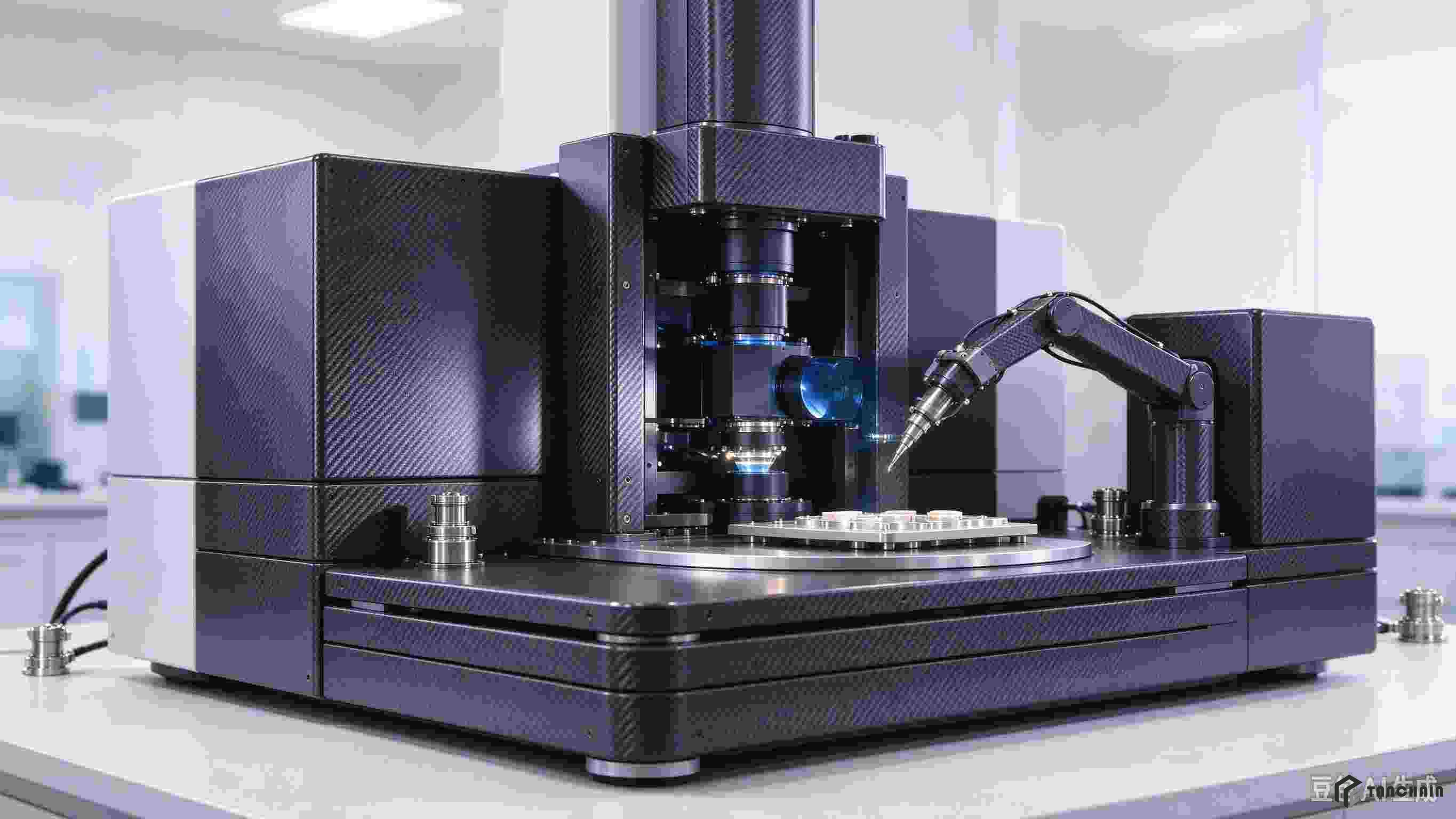
-
Carbon Fiber in Laboratory Equipment and Analytical Instruments
-
Why carbon fiber frames, benches, gantries and rotors outperform aluminium and steel in laboratory instruments - near-zero thermal expansion, high specific stiffness, damping and low moving mass, with specification guidance for instrument designers.
Carbon Fiber in Laboratory Equipment and Analytical Instruments: How to Cut Vibration, Drift and Mass
Visit any analytical laboratory and you will find the same quiet contradiction. A balance that resolves 0.1 mg sits on a granite slab because the floor is not stable enough. A spectrometer that cost six figures is mounted on an aluminium frame that moves a few micrometres whenever the air conditioning switches on. A robot arm loading sample vials is limited not by its motors but by the mass of its own forearm.
Carbon fiber reinforced polymer (CFRP) is increasingly the material that resolves this contradiction. In laboratory equipment and analytical instruments, carbon fiber is not used for decoration or for a premium look. It is used because the three things that limit instrument performance at the top end — vibration, thermal drift, and moving mass — are exactly the things that carbon fiber handles better than steel or aluminium.
This article is written for instrument designers, laboratory equipment OEMs, and laboratory facility engineers who are evaluating composite structures. It explains why the laboratory is such a demanding environment for materials, then works through the main application areas: metrology frames and optical benches, sample handling automation, centrifuge rotors and housings, spectroscopy hardware, and acoustic enclosures. It finishes with the specification points that decide whether a composite part performs for fifteen years or drifts out of tolerance in two.
Part One — Why the Laboratory Is a Materials Problem
Laboratory instruments are unusual among industrial machines because their specification is usually written at the edge of what physics allows. Once a technique reaches its detection limit, the remaining error budget is dominated by the machine itself: how much it flexes, how much it grows when the room warms by one degree, and how much it shakes when a door closes down the corridor.
The error budget is now mechanical
Consider a bench-top optical instrument with a 300 mm optical path. A temperature change of 5 °C on an aluminium frame with a coefficient of thermal expansion near 23 × 10-6 K-1 moves the two ends of that path about 35 µm apart. For a technique that measures interference fringes or focuses a laser spot to a few micrometres, that is not a small error. It is the entire measurement.
The same arithmetic applies to vibration. A structural resonance at 40 Hz is excited by building services, footfall on a suspended floor, and the pump inside the instrument's own chiller. If the frame damps poorly, the amplitude at the sample grows and the signal-to-noise ratio falls. Instrument makers spend large sums on isolation tables to compensate for a frame they could have designed better in the first place.
Moving mass limits throughput
Automatic sample handlers, plate readers, and liquid handling robots are all limited by the inertia of their moving axes. A lighter gantry can accelerate faster, settle sooner, and use smaller motors. In a laboratory running thousands of samples per day, a 20 percent reduction in settle time per move is a real productivity gain, not a theoretical one.
The environment is chemically and thermally hostile
Laboratory benches and fume hoods see acids, solvents, and disinfectants daily. Centrifuge bowls see repeated cycles of high g-force and cleaning agents. Autoclave-adjacent equipment sees steam. Stainless steel survives most of this but corrodes in chloride environments; painted steel eventually chips and becomes a contamination source. A properly sealed composite does not rust, does not need repainting, and can be formulated for specific chemical exposure.
Part Two — The Properties That Decide Instrument Performance
Four material properties matter more than any other in this field, and carbon fiber is unusual in being strong in all four at once.
High specific stiffness
Specific stiffness — elastic modulus divided by density — determines how far a structure deflects under its own weight and under the load of the components it carries. High-modulus carbon fiber composites reach three to five times the specific stiffness of steel and roughly four times that of aluminium. In an optical bench, that means the rail can be thinner and lighter while staying flatter under its own mass.
Tailorable, near-zero thermal expansion
This is the property that makes carbon fiber genuinely unique. Carbon fiber has a slightly negative axial expansion, while epoxy resin expands positively. By choosing the fiber type, the lay-up sequence, and the fiber volume fraction, a designer can tune the laminate's coefficient of thermal expansion close to zero along a chosen axis, or deliberately match it to another material so that two parts grow together rather than against each other.
For a spectrometer frame, zero expansion along the optical axis means the focal plane stays put when the room warms. For a cryostat support, a low-conductivity, low-expansion composite strut carries the load while admitting as little heat as possible.
Damping and acoustic behaviour
Carbon fiber laminates dissipate vibration internally through the viscoelastic response of the resin and through interlaminar shear between plies. Well-designed CFRP structures typically show higher damping than equivalent metal structures and push resonances to higher frequencies, where less energy is available to excite them. In an instrument enclosure, the same property reduces the airborne noise that reaches the operator and the sample.
Low density, and the option to add function
Carbon fiber's density is about 1.6 g/cm3, against 7.8 for steel and 2.7 for aluminium. Beyond simple weight saving, the material can be combined with conductive layers, metal inserts, and shielding meshes so that a single moulded part performs structure, enclosure, and electromagnetic screening at once.
| Property | Aluminium 6061 | Stainless steel 304 | Standard modulus CFRP | High modulus CFRP |
|---|---|---|---|---|
| Density, g/cm3 | 2.70 | 7.90 | 1.55 | 1.60 |
| Axial modulus, GPa | 69 | 193 | 130 | 250 to 350 |
| Specific modulus, GPa per g/cm3 | 26 | 24 | 84 | 160 to 220 |
| Axial CTE, 10-6/K | 23 | 17 | 0 to 2 (tailorable) | -1 to 1 (tailorable) |
| Corrosion in chloride environment | Moderate | Pitting risk | None in sealed laminate | None in sealed laminate |
The table deliberately uses round figures. The point is the ratio, not a datasheet claim: a composite frame can be both stiffer in absolute terms and several times lighter, which is a combination neither metal can offer.
Part Three — Application Map: Where Carbon Fiber Goes in a Laboratory
Laboratory equipment is a broad category, and carbon fiber earns its place differently in each sub-sector. The following map covers the areas where composite construction is already established and where the engineering case is strongest.
Metrology frames, optical benches and laser systems
Optical benches, interferometer bases, and coordinate measuring machine frames are the classic carbon fiber application in precision equipment. The requirement is a structure that stays flat and dimensionally stable over years, under a varying thermal environment, while carrying sensors, mirrors, and stages.
The usual construction is a closed box beam or a bonded tube frame made from high modulus carbon fiber prepreg, cured on a precision mould, then machined and lapped at the mounting interfaces. The face sheets carry bending load, the core or internal ribs carry shear, and the sandwich construction pushes the natural frequency well above the range excited by building vibration.
Where the gain shows up
A granite bench is stiff and stable but very heavy; installing one on an upper floor often requires structural reinforcement of the building. A carbon fiber bench can be a fraction of that mass with comparable or better specific stiffness, which is why portable and mobile instruments — field spectrometers, portable interferometers, and on-site inspection systems — depend on composite frames. The same logic applies in cleanrooms, where a lighter structure reduces particle generation from floor wear and where non-metallic construction avoids metal contamination.
Sample handling robots and liquid handling gantries
Laboratory automation has borrowed heavily from industrial robotics, and the same weight logic applies. A gantry axis that moves a pipetting head across a microplate carries its own beam structure with it on every move. Reducing the beam mass reduces the motor size, the rail wear, the settling time, and the vibration transmitted into the liquid.
Why the beam matters more than the motor
In a typical plate-handling gantry, the moving beam is several times heavier than the payload it carries. Tuning the drive to compensate for that mass is possible, but the inertia still has to be accelerated and then stopped, and the settling time after each stop is governed by the structure rather than by the control loop.
Carbon fiber tubes are the standard solution for the X and Y beams of such gantries, with aluminium or steel end fittings bonded and pinned. For the Z axis and the pipetting head, carbon fiber plate machined to shape provides stiffness where a metal plate would add inertia. The result is a machine that can run faster cycles without splashing, and that keeps positional accuracy after millions of moves.
Centrifuge rotors, buckets and housings
High-speed centrifuges are among the most demanding rotating machines in any laboratory. The rotor must withstand enormous centrifugal stress, resist corrosion from samples and cleaning agents, and fail in a safe, contained way if it is overloaded or worn.
Hoop stress and the case for filament winding
A spinning rotor loads its own material in the hoop direction, so the reinforcement must follow that path. Filament winding places carbon fiber exactly where the stress runs, which is why wound rotors achieve higher burst speeds than machined metal designs of the same mass.
Carbon fiber composite rotors have been used in ultracentrifuges for decades because the specific strength allows higher rotational speeds than metal. The design is not trivial: the laminate must be wound to carry hoop stress, the metal hub must be isolated from the carbon to prevent galvanic corrosion, and the whole assembly must pass containment and fatigue testing. Where those requirements are met, a composite rotor reaches higher g-force and spins up faster because of its lower inertia.
Fixed-angle and swing-out buckets, rotor covers, and the centrifuge's inner containment ring are also produced in carbon fiber. The housing and lid benefit from the material's damping, which reduces the noise and the vibration transmitted to the bench.
Spectroscopy and analytical instrument hardware
Spectrometers, chromatographs, and mass spectrometers contain several composite opportunities. The optical rail that carries gratings, slits, and detectors is often a carbon fiber tube or plate chosen for thermal stability. The vacuum chamber support structure in a mass spectrometer may use composite struts to limit heat transfer while carrying the chamber load.
Sample cells and flow components are less commonly carbon fiber, because wetted surfaces need specific chemical compatibility. But the frames, covers, and mounting hardware around them are increasingly composite, and the trend toward portable and field-deployable instruments — Raman, XRF, and portable mass spectrometry — depends on lightweight structural design.
Stable mounting under a moving load
In a chromatography system, the detector and column compartment are often carried on a frame that also holds the solvent pumps. A composite frame that resists deflection under that changing load keeps the optical or electrical path aligned, which matters most when the instrument runs unattended overnight.
Acoustic enclosures, fume hoods and cleanroom furniture
Laboratory noise is an underrated problem. Vacuum pumps, compressors, and chillers run continuously, and their sound reaches the operator and the sensitive instrument. A sandwich panel with carbon fiber skins and a lightweight core provides high stiffness with useful acoustic damping, and can be moulded into shaped enclosures that a metal fabrication shop could not produce economically.
In fume hoods, carbon fiber and hybrid composite liners resist the acid and solvent vapours that attack coated steel. In cleanroom furniture, composite benches and shelves avoid the particle shedding of painted metal and the corrosion of stainless steel in hydrogen peroxide vapour decontamination cycles.
Surgical and dental equipment in the laboratory
Where laboratory work meets medical device design, carbon fiber appears in imaging tables, C-arm components, and instrument trays that must be radiolucent. A carbon fiber table top lets X-rays pass with minimal attenuation, so the imaging dose can be lower and the image quality higher. The same property is valued in dental and veterinary imaging equipment and in laboratory animal imaging systems.
Part Four — Matching the Material Form to the Part
Carbon fiber is not a single product. The form in which it arrives determines the manufacturing route, the achievable geometry, and the cost. Instrument designers usually work with four forms.
Prepreg for high-performance laminates
Pre-impregnated carbon fiber fabric or unidirectional tape, supplied with a controlled resin content, is the standard input for autoclave or press-cured structural parts. It gives the highest fiber volume fraction and the most predictable mechanical properties, which is why optical benches and metrology frames are usually built from it. The trade-off is tooling cost and cure time, which favours designs produced in modest volumes.
Pultruded tubes and profiles for frames and gantries
Pultrusion produces continuous constant-section profiles with excellent axial stiffness at a comparatively low unit cost. For gantry beams, support columns, and instrument frames, a pultruded carbon fiber tube with a controlled wall thickness is often the most economical way to get high stiffness. Standard profiles are available in round, square, and rectangular sections, and custom dies can produce more complex shapes.
Plates and machined components
Carbon fiber plate, laminated and cured in a press, can be machined on a CNC router or mill into brackets, mounting plates, and structural links. This route suits prototype work and low-volume instruments, where the design changes between builds, and it allows precise features such as counterbores and threaded inserts to be cut after curing.
Designing for a bonded rather than welded structure
Composite frames are usually bonded and bolted rather than welded. That changes the design language: joints need overlap and adhesive selection rather than a weld bead, and the assembly sequence has to be planned before the first part is cured.
Fabric, chopped fiber and hybrid nonwovens
Woven carbon fiber fabric is used where a laminated skin is laid up by hand or by resin infusion, and where a cosmetic surface matters. Chopped carbon fiber and milled fiber are used as fillers in moulding compounds for less critical housings, where the goal is stiffness and conductivity rather than maximum strength.
Two companion materials often appear alongside carbon fiber in laboratory equipment. Aramid fiber, with its high impact resistance and low density, is used in protective covers, instrument cases, and cut-resistant components. Pre-oxidized (PANOX) fiber, which is inherently flame retardant and electrically non-conductive, is used in thermal insulation, fire barriers around equipment, and cable protection where a fire in one instrument must not spread to the next.
Part Five — What Buyers and Designers Should Verify
Composite parts for instruments are long-life purchases, and the differences between a good and a mediocre supplier only appear after years of service. The following points are worth building into any technical enquiry.
Fiber type and modulus. Standard modulus, intermediate modulus, and high modulus fibers differ substantially in stiffness and price. Ask which grade is specified and request the actual laminate test data, not the fiber datasheet alone.
Laminate schedule and fiber orientation. A quasi-isotropic lay-up behaves very differently from a unidirectional one. For optical benches, the schedule should be designed around the thermal expansion requirement, and the supplier should be able to explain it.
Resin system and service environment. Epoxy is standard, but cyanate ester offers lower moisture absorption and better dimensional stability in humid conditions, and bismaleimide or thermoplastic systems suit higher temperatures. Match the resin to the cleaning agents and sterilisation cycles the part will see.
Thermal expansion verification. Ask for measured CTE data on a coupon from the production laminate, not a calculated value. For precision instruments, the difference between 0.5 and 2 × 10⁻⁶ K-1 decides the specification.
Machining and flatness tolerances. Composite plates are usually ground or lapped after curing to achieve flatness. Confirm the achievable tolerance, the measurement method, and how the supplier controls it across a production batch.
Metal-to-composite interfaces. Inserts, bonded fittings, and fasteners are the usual weak points. Specify the insert type, the pull-out load, and whether the design isolates the carbon from dissimilar metals to prevent galvanic corrosion.
Outgassing and cleanliness. For vacuum or cleanroom instruments, ask for outgassing data and confirm that the resin and any release agents are compatible with the required cleanliness class.
It is also worth asking how the supplier handles prototypes. Instrument development is iterative, and a partner who can deliver a machined prototype plate in two weeks and then scale to pultruded or moulded production parts is far more useful than one who only quotes at high volume.
Part Six — Trends Shaping the Next Generation of Laboratory Equipment
Three trends are pushing carbon fiber further into the laboratory. The first is miniaturisation and portability: instruments that once occupied a bench are now expected to travel to the sample, whether that sample is in a field station, a hospital ward, or a production line. Every gram removed from the frame and enclosure extends battery life and reduces operator fatigue.
The second is higher throughput automation. As laboratories consolidate and run larger sample batches, the economics of faster gantry motion and lower maintenance become decisive, and composite moving structures are the straightforward way to get there.
The third is sustainability and lifecycle cost. Composite structures do not corrode, need no repainting, and hold their dimensions for decades, which reduces both maintenance and the replacement of entire instruments. As laboratories formalise their environmental reporting, a longer service life becomes a purchasing argument in its own right.
Part Seven — Sourcing Carbon Fiber for Laboratory and Instrument Applications
Shanghai Tanchain New Material Technology supplies carbon fiber, aramid, and pre-oxidized fiber in the forms that instrument manufacturers need: continuous filament and tow, woven fabric and unidirectional cloth, prepreg, pultruded tubes and profiles, laminated plate, and finished composite components. For laboratory equipment, the most frequently requested products are high modulus carbon fiber prepreg for optical benches and metrology frames, pultruded carbon fiber tubes for automation gantries, and machined carbon fiber plates for brackets and mounting hardware.
If you are designing a new instrument or looking for a more stable alternative to an existing aluminium frame, the most useful first step is a short technical conversation about the error budget, the thermal environment, and the production volume. From there the right fiber grade, laminate schedule, and manufacturing route usually become clear.
Browse our carbon fiber product range or contact our technical team to discuss carbon fiber for laboratory equipment and analytical instruments, and request a quotation or a prototype sample for your project.