


-
Carbon Fiber in Rail and Rolling Stock: Inside the Shift Toward Lighter Trains
-
How carbon fiber composites are moving from interior panels into the primary load-bearing structures of trains, with real-world weight, energy and cost data, material formats, manufacturing routes, fire certification requirements and procurement checkpoints for rail and rolling stock programs.
Carbon Fiber in Rail and Rolling Stock: Inside the Shift Toward Lighter Trains
Rail has always been one of the most energy-efficient ways to move people and freight. The challenge today is no longer whether trains are efficient, but whether they can become meaningfully lighter without giving up strength, service life, or passenger safety. That question has pushed carbon fiber composites from the margins of rail engineering into the primary load-bearing structures of modern rolling stock.
This article looks at how carbon fiber actually behaves in real rail projects, where it is being used today, and what a procurement team should verify before committing to composite structures. Below is a short index so you can move directly to the section you need.
Index of This Article
01 — Why weight matters more in rail than in almost any other vehicle class
02 — A brief history: from interior panels to load-bearing car bodies
2.1 Non-structural phase
2.2 Semi-structural phase
2.3 Primary structure phase
03 — Where carbon fiber components are used on a train
3.1 Car body shell
3.2 Bogie frame
3.3 Pantograph and roof equipment
3.4 Interior and doors
04 — The real numbers behind lightweighting
05 — Materials and formats used in rail production
06 — Manufacturing routes: which process fits which part
07 — Fire, smoke, and toxicity: the rail-specific hurdle
08 — Costs, service life, and how to justify the premium
09 — What to check before specifying carbon fiber
10 — Outlook
01 — Why Weight Matters More in Rail
A train spends its whole service life accelerating, braking, and holding itself up. Every kilogram of vehicle mass is paid for repeatedly, on every trip, for twenty or thirty years. In rail economics, mass is not a one-time design decision — it is a recurring operating cost.
The consequences of excess mass appear in several places at once. Higher axle loads increase track wear and maintenance frequency. Slower acceleration reduces line capacity during peak hours. Greater braking energy demand raises electricity or fuel consumption. Each of these effects compounds the others.
1.1 The Energy Equation
Energy consumption in rail has two major components: energy used to accelerate the vehicle and energy used to overcome rolling and aerodynamic resistance. Mass reduction works on both, but it is especially effective at low speeds and in metro duty cycles where trains stop and start constantly.
A vehicle that is lighter also recovers more energy during regenerative braking relative to its own mass, which improves the return from the traction system already installed.
1.2 The Infrastructure Side
Reducing unsprung and axle mass lowers dynamic loads on the track, switches, and bridges. On older networks with tight bridge load limits, this can matter more than the energy savings, because it allows new vehicles to run on infrastructure that would otherwise require reinforcement.
02 — A Brief History: From Panels to Load-Bearing Structure
Composite materials did not arrive in rail as structural solutions. They entered through the door marked "interior."
2.1 Non-Structural Phase
Early use was limited to interior panels, seat shells, toilet modules, and other components where low weight and design freedom mattered more than load carrying. These parts were easy to justify: they never carried primary loads, and failure would not compromise safety.
2.2 Semi-Structural Phase
The next stage moved composites into semi-structural roles such as exterior fairings, front-end covers, and equipment housings. Here engineers began to combine composite skins with metal frames, learning how the two material families behave together under vibration and thermal cycling.
2.3 Primary Structure Phase
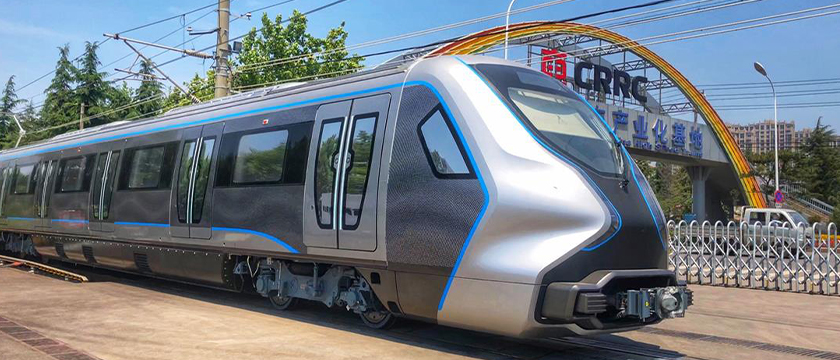
The current phase places composites in primary load paths. The clearest recent example is the entry into commercial service of a metro train whose car body and bogie frames are built with carbon fiber composites, carrying passengers in normal daily operation rather than in a demonstration program.
That transition is significant because it changes the certification conversation. Once composites carry primary loads, the discussion is no longer about weight savings alone but about fatigue behavior, damage tolerance, inspection intervals, and repair procedures that can be executed in a real depot.
03 — Where Carbon Fiber Components Are Used on a Train
3.1 Car Body Shell
The carbody is the largest single mass item on most passenger vehicles. Replacing steel or aluminum with a composite shell has produced reported weight reductions in the range of about one quarter of the body structure mass, while allowing large, integrated shapes that reduce part count and fastener quantity.
The design freedom is often undervalued. Composite shells can integrate cable ducts, mounting points, and aerodynamic surfaces into a single layup, removing joints that would otherwise need sealing and inspection over decades of service.
3.2 Bogie Frame
The bogie is where lightweighting pays the largest dividends, because its mass is unsprung or partially unsprung. Reducing it improves track interaction, lowers wear, and reduces transmitted vibration. Reported reductions for composite bogie frames have reached roughly half the mass of an equivalent metal frame.
Fatigue performance is the key requirement here. A bogie frame sees billions of small load cycles over its life, so the laminate design must account for damage accumulation rather than only ultimate strength.
3.3 Pantograph and Roof Equipment
Roof-mounted components sit high on the vehicle, which amplifies their effect on center of gravity. Carbon fiber is well suited to pantograph arms, cable trays, and equipment enclosures here, where stiffness and low mass both matter and where electrical insulation can be an additional benefit.
3.4 Interior and Doors
Interior parts remain a strong application area. Door leaves, partition panels, luggage racks, and seat structures benefit from composite stiffness and from the ability to mold complex geometry that metal would require multiple parts to achieve.
04 — The Real Numbers Behind Lightweighting
Figures from recent commercial deployments are useful as orientation rather than as universal benchmarks. One widely reported carbon fiber metro train achieved a carbody roughly 25 percent lighter and a bogie around 50 percent lighter than comparable metal designs, for an overall vehicle reduction near 11 percent. That translated into an operational energy reduction of about 7 percent and an estimated annual CO2 reduction of around 130 tonnes per train.
The important insight is the ratio. A relatively modest overall weight reduction produces a disproportionate result in operating cost, because rail vehicles pay for their mass continuously across a very long service life.
4.1 Secondary Benefits That Pricing Models Miss
Composite structures also change vibration and noise characteristics. Damping behavior reduces interior noise, which improves passenger comfort, and lower vibration transmission reduces wear on adjacent components. Over a long service window, these effects influence maintenance cost in ways that a simple energy calculation does not capture.
05 — Materials and Formats Used in Rail Production
Carbon fiber reaches rail manufacturing in several material forms, and the choice of form usually follows the chosen production process rather than the other way around.
5.1 Continuous Fiber and Tow
The continuous carbon fiber tow format is the input for winding, pultrusion, and automated fiber placement. In rail, carbon fiber tow is used for structural profiles, long stiffeners, and pressure components where continuous carbon fiber alignment along the load path is essential.
5.2 Prepreg
Prepreg offers controlled resin content and consistent mechanical properties, which supports certification because the input material has a documented and repeatable specification. It is common in high-value structural parts where variability cannot be tolerated.
5.3 Fabrics and Multiaxial Textiles
Woven and multiaxial fabrics provide handling characteristics and drape that suit complex double-curved geometries such as front ends and interior components. Fabric construction also affects impact behavior, which is relevant for parts exposed to ballast, debris, or passenger contact.
5.4 Sandwich Construction
Many rail components are sandwiches: composite skins bonded to a lightweight core. This configuration delivers high bending stiffness with low mass, and it is widely used in floor panels, side walls, and roof structures.
5.5 Companion Materials
Not every composite part on a train uses carbon fiber. Aramid fibers are frequently specified for impact-prone panels and protective linings where energy absorption matters more than maximum stiffness. Pre-oxidized fiber products serve fire-barrier and thermal insulation roles inside the vehicle envelope. These materials are often selected together with carbon fiber as part of one integrated materials strategy.
06 — Manufacturing Routes: Which Process Fits Which Part
6.1 Resin Transfer and Infusion
Liquid molding routes suit large, integrated panels produced in moderate volumes. They allow a dry fiber preform to be placed in a closed or vacuum-bagged tool and infused with resin, which is efficient for carbody sections that would be impractical to autoclave.
6.2 Autoclave Curing
Autoclave curing delivers the highest and most consistent fiber volume fraction, and it remains the reference process for critical structural parts. Its constraints are part size and cycle time, which limit it to smaller or higher-value components.
6.3 Pultrusion
Pultrusion produces constant cross-section profiles continuously. For rail, this fits cable ducts, structural stiffeners, and even track-related components where a repeatable profile and high fiber alignment are required at a competitive cost per meter.
6.4 Filament Winding
Winding is used for cylindrical and pressure-containing parts, including gas storage cylinders carried on rail maintenance vehicles and track machines that run on compressed or alternative fuels.
6.5 Compression Molding and Thermoplastic Routes
For higher volumes of smaller parts, compression molding of sheet molding compound or thermoplastic laminates offers short cycle times and the possibility of welding and reforming. Thermoplastic composites are of particular interest because they can potentially be recycled and repaired more easily than thermoset systems.
07 — Fire, Smoke, and Toxicity: The Rail-Specific Hurdle
In rail, fire performance is not a secondary consideration. Trains operate in tunnels, carry large numbers of people, and may be far from an evacuation point. Materials must meet demanding standards for flame spread, smoke density, and toxicity of combustion gases.
This is the single biggest reason composite adoption in rail has been slower than in aerospace or motorsport. Certification is not limited to the fiber; it covers the entire resin system, the core material, adhesives, and coatings, and it must hold for the finished assembly rather than for a coupon.
7.1 How Suppliers Respond
Formulators have developed phenolic, modified epoxy, and other resin systems engineered for low smoke and low toxicity. Additives and intumescent layers further improve performance. The practical consequence for buyers is that the resin system is often the deciding factor in whether a composite design can be certified, not the fiber itself.
7.2 Where Pre-Oxidized Fibers Fit
Pre-oxidized fiber products are non-flammable and are used as thermal barriers and fire-blocking layers within composite assemblies. Placing them strategically allows a structure to meet fire requirements while keeping the structural carbon fiber laminate unchanged.
08 — Costs, Service Life, and How to Justify the Premium
Carbon fiber components carry a higher unit cost than steel or aluminum, and honest procurement discussions should start there rather than avoid it. The justification rests on whole-life cost.
8.1 The Three Cost Levers
Energy: lower mass reduces traction energy across every trip of the vehicle's life.
Infrastructure: lower dynamic loads reduce track and structure maintenance expenditure.
Capacity: better acceleration enables tighter timetables and more service from the same fleet.
8.2 Where Composites Win First
Adoption tends to start where the arithmetic is clearest: bogies, roof equipment, doors, and interior structures. These parts are bounded in size, their loads are well understood, and their mass reduction produces immediate measurable benefit. Full carbody replacement follows once certification pathways and depot repair capability are established.
8.3 Repair and Inspection Reality
A composite fleet requires different maintenance skills than a metal fleet. Depots need trained technicians, defined inspection intervals, and approved repair schemes for impact damage and delamination. This is a real cost, and it should be planned at the procurement stage rather than discovered later.
09 — What to Check Before Specifying Carbon Fiber
9.1 Material Traceability
Ask for fiber specification, sizing compatibility with the selected resin, and batch-level traceability. In rail certification, the ability to demonstrate consistent input material is as important as the measured properties of a single sample.
9.2 Resin and Fire Certification Together
Never evaluate a fiber in isolation from the resin system. Confirm that the proposed fiber and resin combination has been tested as an assembly against the fire, smoke, and toxicity requirements that apply to the target network.
9.3 Fatigue Data, Not Just Static Strength
Rail structures are fatigue-dominated. Request test data covering cyclic loading at relevant stress ratios rather than relying on ultimate tensile figures, which describe a condition the part will rarely see.
9.4 Supplier Capability Beyond Fiber
Structural rail parts require more than fiber supply. Confirm the supplier can support format selection, provide consistent fabric or prepreg characteristics, and work with the converter on process windows. A partner who understands the downstream process reduces the risk of avoidable rework.
10 — Outlook
The direction of travel in rail is clear. Lightweighting is one of the few levers that simultaneously reduces operating cost, lowers emissions, and reduces infrastructure wear, and carbon fiber is the material family best positioned to deliver it at structural scale.
The open questions are practical rather than fundamental: how quickly certification pathways mature, how broadly depot repair capability spreads, and how rapidly thermoplastic and automated processes bring unit costs down. Each of these is advancing, and the first commercial carbon fiber metro train already demonstrated that the concept survives contact with daily passenger service.
10.1 What Comes Next
Expect the next wave of carbon fiber applications to focus on modular carbon fiber structural assemblies that can be certified once and reused across vehicle platforms, plus growing use of mixed-material strategies where carbon fiber, aramid fiber, and pre-oxidized fiber products each handle the function they perform best.
10.2 Working With the Right Partner
Whether you are specifying a composite bogie frame, a carbody section, an interior panel system, or fiber materials for a rail program in development, the choice of material format and supplier capability shapes the entire project. We supply carbon fiber precursor, filament, staple fiber, fabrics, prepreg, and finished composite parts, along with aramid filament, aramid staple fiber, aramid fabrics, and a full range of pre-oxidized fiber products in tow, filament, staple, yarn, fabric, and felt form.
If you are evaluating carbon fiber for a rail or rolling stock application, send us your load case and fire requirements. We will help you match material format and process route to the part, so the design is buildable and certifiable rather than only light on paper.