


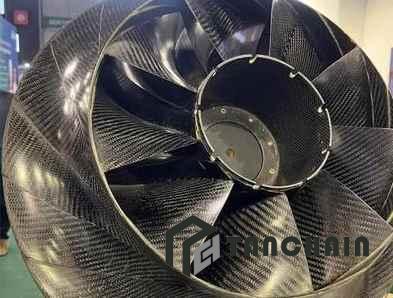
Carbon fiber has quietly become part of the equipment people use every day. Behind the walls of the modern home and the roof of the modern factory sits a growing population of machines — compressors, fans, pumps, heat exchangers and precision appliances — and each of them is caught in the same squeeze: get quieter, run more efficiently, hold tighter tolerances, and last longer, all while getting lighter. This article reviews the real applications of carbon fiber in the heating, ventilation and air-conditioning (HVAC) and appliance industries, the material forms used at each point, and the engineering problems the material solves. It is written for procurement teams and design engineers who need a practical map rather than a slogan.
1. Why the HVAC and Appliance Industry Is Reaching for Composites
The HVAC and appliance sector does not buy carbon fiber for exotic reasons. It buys it because three pressures have become unavoidable at once.
The first is efficiency. Motor-driven equipment — compressors, fans, blower wheels, pumps — consumes most of the energy in a cooling or ventilation system, and every gram of rotating mass raises the torque needed to accelerate it. Lightweight rotating parts reach speed sooner, need smaller motors and draw less power on every cycle.
The second is acoustics. Vibration is noise, and noise is a complaint. A fan blade that flexes at its natural frequency radiates resonance; a housing that transmits vibration to the mounting frame turns a quiet machine into a loud one. Materials with high damping interrupt that path.
The third is spatial and thermal discipline. Indoor units are shrinking while their performance ratings climb, and outdoor units face decades of rain, salt air and temperature cycling. A material that is stiff, light, dimensionally stable and does not rust simultaneously answers all three pressures.
2. Carbon Fiber Applications Across HVAC and Appliance Equipment
Carbon fiber enters the product at many different points, and it is worth walking through them category by category, because the material form changes with the duty.
2.1 Fan and Blower Components
Fans are the single largest opportunity. A carbon fiber fan blade and a carbon fiber blower wheel weigh a fraction of the aluminium or steel equivalent, which lowers start-up torque, reduces bearing load and extends motor life. Because the composite can be moulded into complex airfoil shapes, aerodynamic efficiency improves at the same time. The high specific stiffness also pushes the blade's natural frequency above the operating range, so the blade no longer resonates at speed — a direct reduction in tonal noise. Carbon fiber prepreg and carbon fiber fabric are the common starting forms, laid up and cured into the final blade geometry.
2.2 Compressor and Pump Internals
Scroll and screw compressor components and pump impellers demand stiffness under pressure and resistance to corrosion from refrigerants, lubricants and process fluids. Carbon fiber plate and machined carbon fiber parts hold tight tolerances and resist the chemical attack that degrades metals. Where the compressor operates at high speed, the low inertia of composite rotating parts reduces vibration and improves balance, which translates into longer service intervals.
2.3 Heat Exchanger and Condenser Structures
Heat exchangers in modern systems increasingly use composites for headers, end plates and support frames. The low thermal expansion of carbon fiber keeps clearances stable as the unit heats and cools, prevents the thermal fatigue cracking that shortens metal component life, and avoids the galvanic corrosion that appears wherever dissimilar metals meet moisture. Carbon fiber tube and pultruded profiles provide the structural members, while gaskets and seals benefit from aramid fiber's toughness and thermal stability.
2.4 Precision Appliance Mechanisms
Inside high-end appliances — washer drums, dishwasher arms, robotic vacuum chassis, precision dispensing units — carbon fiber plate and tube deliver the repeatability that metal struggles to hold. A composite drum is lighter, which reduces the energy needed for every spin cycle and cuts cabinet vibration, while a composite structural chassis lowers the mass a battery-powered appliance has to carry. Dimensional stability keeps moving parts aligned over thousands of cycles.
2.5 Insulation, Sealing and Fire Protection
HVAC equipment concentrates heat and electricity in a small envelope, and that demands materials that are thermally stable and electrically safe. Pre-oxidized fiber (PANOX) felt, yarn and fabric provide flame-resistant, high-temperature insulation around motors, heater banks and cabling, without the charring and smoke of ordinary organic textiles. Aramid fabric reinforces flexible ducts, vibration isolation pads and protective liners, adding abrasion resistance and impact toughness where the composite meets the moving world.
3. Material Forms and Where Each One Fits
Carbon fiber is not one product. The table below maps common HVAC and appliance duty points to the recommended product form and the dominant property it delivers. It is a first-pass guide; the final choice should be confirmed against the actual load path, thermal budget and acoustic target.
| Equipment duty point | Recommended product form | Dominant property | Replaces traditional solution |
|---|---|---|---|
| Fan blade and blower wheel | Carbon fiber prepreg layup | Low inertia, high natural frequency | Aluminium or steel blade |
| Compressor housing and end plate | Carbon fiber plate, machined part | Stiffness, corrosion resistance | Cast metal housing |
| Pump impeller | Carbon fiber prepreg, machined composite | Chemical resistance, low inertia | Stainless steel impeller |
| Heat exchanger header and frame | Carbon fiber tube, pultruded profile | Low thermal expansion, stiffness | Welded metal frame |
| Structural chassis and brackets | Carbon fiber plate and tube | Stiffness-to-weight | Stamped steel or aluminium |
| Washer drum and rotating housing | Carbon fiber composite moulding | Low mass, dimensional stability | Stainless steel drum |
| Motor and heater insulation | Pre-oxidized fiber felt, yarn, fabric | Flame resistance, thermal stability | Conventional organic textiles |
| Flexible duct and vibration pad | Aramid fabric and staple | Abrasion and impact resistance | Coated fabric liner |
| Panel and enclosure skin | Carbon fiber fabric, decorative weave | Light weight, surface finish | Painted metal panel |
The table is a starting point, not a substitute for engineering. Two duty points that look similar can require different fibre architectures once vibration mode shapes, temperature gradients and chemical exposure are taken into account.
4. The Engineering Case for Carbon Fiber Here
The benefits of composites in HVAC and appliances follow from measured material properties rather than marketing language.
4.1 High Specific Strength and Stiffness
Carbon fiber reinforced polymer has a density around 1.6 g/cm³ against roughly 2.7 g/cm³ for aluminium and 7.8 g/cm³ for steel. On a weight-for-weight basis it is far stiffer than either metal, so a composite part can match the rigidity of a metal equivalent at a fraction of the mass. In rotating equipment that reduction flows straight into motor sizing, bearing load and energy consumption.
4.2 Vibration Damping
Composites dissipate vibration internally far better than metals. The polymer matrix converts vibrational energy into heat instead of transmitting it to the structure, which suppresses the resonance that causes tonal noise and fatigue. For an indoor unit mounted close to living space, this is often the difference between a product that passes an acoustic test and one that does not.
4.3 Corrosion Resistance and Long Life
Unlike steel, the polymer matrix does not rust, and carbon fiber resists the refrigerants, cleaning agents and humidity found in real installations. Outdoor condenser units, coastal installations and humid laundry environments all benefit from a structure that does not need protective coating maintenance to survive.
4.4 Low Thermal Expansion and Dimensional Stability
Carbon fiber exhibits a low coefficient of thermal expansion, particularly along the fibre direction. Components that heat and cool every cycle therefore move very little, which preserves clearances, seals and bearing alignment across a long service life.
4.5 Design Freedom
Because laminates are built up ply by ply, stiffness can be placed exactly where the load demands it and nowhere else. A fan blade, a bracket or a housing can be given an optimised shape that metal forming cannot easily produce, allowing the designer to trade mass against performance with precision.
5. Practical Implementation Notes
Carbon fiber delivers its promise only when specified correctly. These are the points we raise with equipment clients during material selection.
Balance stiffness against acoustics: specify the fibre architecture so the first natural frequency clears the operating range with margin, rather than simply copying the metal part.
Confirm chemical compatibility: validate the resin system against every refrigerant, lubricant and cleaning agent the part will contact.
Harden electrical safety: use aramid or pre-oxidized fiber insulating layers with the correct thermal class where the part sits near motors, heaters or high-voltage wiring.
Prevent galvanic corrosion: isolate carbon fiber from metal fasteners and frames so the joint does not become a corrosion cell in humid service.
Design the joint, not just the part: plan bonded and bolted interfaces for the real thermal and vibration cycle, keeping preload stable over time.
Specify finish and cleanability: for appliance surfaces, agree on surface treatment and cosmetic grade so the part meets both strength and appearance requirements.
Require traceability: document fibre content, layup schedule and dimensional inspection for every delivered part, particularly where safety or warranty depends on it.
6. Trends Shaping the Next Generation of Equipment
Several forces are pushing carbon fiber deeper into HVAC and appliances. The first is the global shift to higher-efficiency refrigerant systems and variable-speed compressors, which rewards every reduction in rotating mass and every point of acoustic improvement. The second is the electrification of domestic equipment, where battery-powered appliances and heat pumps must carry or drive their own mass, making lightweight structure a direct range and efficiency multiplier. The third is the tightening of building acoustic regulations, which turns vibration damping from a premium feature into a compliance requirement. The fourth is the growth of data-centre and industrial cooling, where large air-handling and liquid-cooling units need stiff, corrosion-free structures that hold tolerances for decades. In every case the enabling theme is identical: a material that is stiff, light, quiet and stable.
Shanghai Tanchain New Material Technology supplies the complete fiber stack behind HVAC and appliance programmes — carbon fiber precursor and filament, carbon fiber staple, fabric, prepreg, plate, tube and pultruded profiles, together with aramid filament, aramid staple and aramid fabric, and the full pre-oxidized fiber range of filament, staple, yarn, felt and fabric. Whether the task is a fan blade redesign, a compressor housing programme or a new lightweight appliance chassis, our team can advise on the material form, fibre architecture and resin system that fit the duty cycle. Browse our carbon fiber product range or send an enquiry to discuss the specification for your next HVAC or appliance project.