


-
How Carbon Fiber Is Transforming Building Reinforcement and Structural Strengthening
-
Discover how carbon fiber building reinforcement strengthens concrete beams, columns, bridges, and masonry with lightweight, corrosion-resistant CFRP materials.
Why Carbon Fiber Is Reshaping Building Reinforcement
Buildings and civil structures age. Concrete cracks, steel corrodes, and load requirements keep rising as cities grow denser. For decades, engineers relied on heavy steel plates and bulky concrete jackets to repair and strengthen these structures. Today, carbon fiber building reinforcement has become one of the most practical and cost-effective solutions in modern construction. Carbon fiber reinforced polymer, commonly called CFRP, offers exceptional tensile strength at a fraction of the weight of steel, making it possible to strengthen bridges, floors, columns, and walls without adding significant load to the existing structure.
This article explains how carbon fiber is used for structural strengthening, where it performs best, and what buyers should look for when sourcing carbon fiber materials for building reinforcement projects.
What Makes Carbon Fiber Ideal for Structural Strengthening
Carbon fiber composites combine very high tensile strength with very low density. A carbon fiber laminate can reach tensile strengths far beyond ordinary structural steel while weighing roughly one quarter as much. For reinforcement work, this ratio is the key advantage. When a structure is already carrying its own dead load, adding heavy steel plates can create new problems instead of solving them. Carbon fiber building reinforcement avoids that trap entirely.
Carbon fiber is also highly resistant to corrosion, which is critical in humid, coastal, and industrial environments. Unlike steel, it does not rust when exposed to moisture, salt, or chemicals. It resists fatigue well, holds its shape under sustained load, and can be bonded directly onto curved and irregular surfaces. These properties allow engineers to strengthen structures with minimal disruption and often without changing the building's appearance.
Strengthening Concrete Beams and Slabs with Carbon Fiber
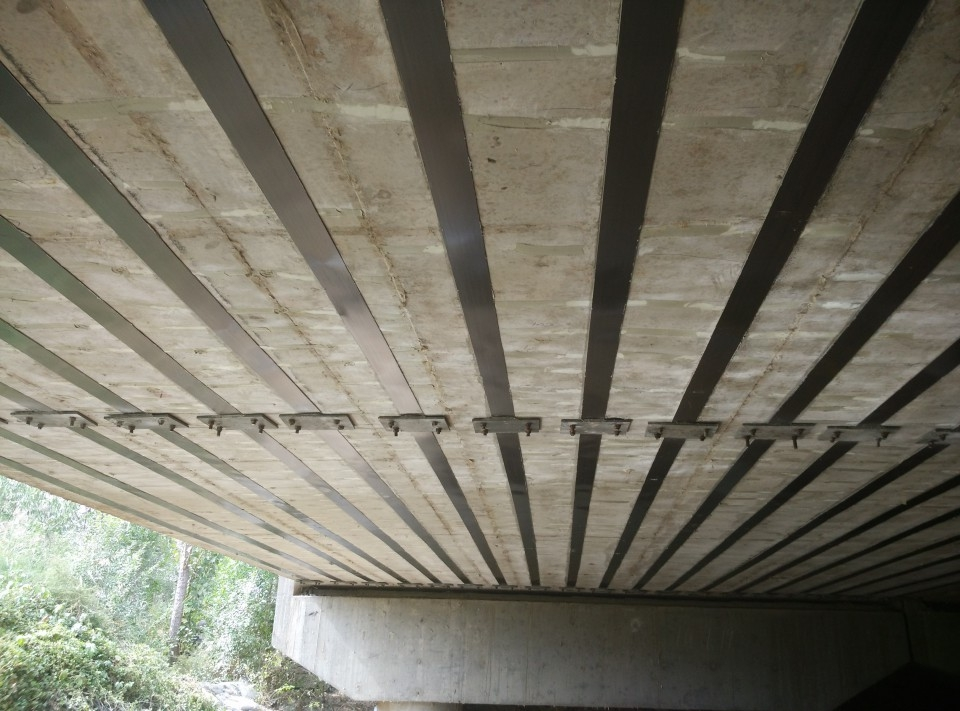
One of the most common applications of carbon fiber building reinforcement is flexural strengthening of concrete beams and slabs. When a floor must carry heavier equipment, more occupants, or increased storage loads, carbon fiber fabric and carbon fiber plate are bonded to the tension face of the concrete. The reinforcement takes over part of the tensile stress, reducing cracking and increasing the load capacity of the member.
Carbon fiber plate is especially useful for beam strengthening because it delivers a high stiffness contribution in a thin, flat profile. Carbon fiber fabric, applied with epoxy in multiple layers, offers more flexibility on uneven surfaces and around corners. For slabs and bridge decks, carbon fiber strips bonded along the span can control deflection and extend the service life of the structure. Because the material is thin and light, ceiling height and floor thickness are barely affected, which matters greatly in renovation projects.
Column Confinement and Seismic Retrofitting
Columns are the backbone of any building, and their failure during an earthquake can be catastrophic. Wrapping columns with carbon fiber fabric is now a widely accepted seismic retrofitting method. The wrap creates a confining effect that increases the compressive strength of the concrete and dramatically improves ductility, allowing the column to deform without sudden collapse.
This technique is particularly valuable for older reinforced concrete buildings designed before modern seismic codes. Carbon fiber wrapping can be installed quickly, with limited noise and dust compared to traditional concrete jacketing. Circular and rectangular columns, bridge piers, and shear walls can all be strengthened this way. The result is a structure that behaves far better under lateral loads, protecting both the building and the people inside it.
Repairing and Extending the Life of Bridges and Infrastructure
Bridges face a demanding combination of traffic loads, weather exposure, and aging materials. Carbon fiber building reinforcement has become a standard tool for bridge rehabilitation. Deteriorated girders, cracked deck soffits, and corroded prestressed elements can be repaired and strengthened with carbon fiber composites, often without closing the bridge for extended periods.
Because carbon fiber does not corrode, it is an excellent choice for structures exposed to deicing salts, marine air, and industrial pollution, environments where steel repairs would soon deteriorate again. Lightweight carbon fiber systems can also be installed from scaffolding or access platforms with less risk and lower cost than conventional methods. Many infrastructure authorities now specify carbon fiber strengthening in their standard repair guidelines for precisely these reasons.
Masonry, Walls, and Historic Building Retrofitting
Older masonry and brick buildings present special challenges. Unreinforced masonry walls are brittle and vulnerable to out-of-plane failure during earthquakes or high winds. Carbon fiber reinforcement applied to wall surfaces increases their flexural strength and helps tie the structure together. Because carbon fiber strips are thin and can be finished with paint or plaster, this approach is well suited to historic preservation projects where the visual character of a building must be protected.
Carbon fiber building reinforcement allows engineers to upgrade heritage structures without altering their appearance or adding substantial weight to fragile foundations. Vaults, arches, domes, and partition walls can all be reinforced discreetly. This combination of invisible strengthening and reversible or minimally invasive installation has made carbon fiber a preferred solution for restoration work worldwide.
Key Carbon Fiber Products Used in Building Reinforcement
Building reinforcement relies on several carbon fiber product forms, each suited to specific tasks. Carbon fiber fabric is the most versatile option, applied with epoxy resin to conform to beams, columns, and walls. Unidirectional carbon fiber fabric places all fibers in the load direction for maximum efficiency in flexural and shear strengthening.
Carbon fiber plate offers high stiffness in a flat, pre-cured profile ideal for beam and slab strengthening where a thin, clean finish is desired. Carbon fiber sheet and carbon fiber tube are used for structural framing, bracing, and specialized supports. Carbon fiber prepreg provides consistent resin content and mechanical properties for factory-produced reinforcement elements.
Pultruded carbon fiber profiles, made from carbon fiber tow combined with resin, deliver reliable, uniform properties for industrial and infrastructure applications. For projects that also require heat or chemical resistance, aramid and oxidized fiber materials can complement carbon fiber systems.
Installation Advantages That Save Time and Cost
One reason carbon fiber building reinforcement has grown so quickly is the speed of installation. Surface preparation, adhesive application, and placement can be completed in hours rather than weeks. There is no heavy lifting equipment, no welding, and no need to shut down entire floors or buildings.
Project costs benefit in several ways. Lower material weight reduces transportation and handling expenses. Faster installation reduces labor hours and business interruption. Extending the life of an existing structure is often far cheaper than demolition and reconstruction, and it also avoids the environmental impact of producing large volumes of new concrete and steel. For owners and contractors, carbon fiber strengthening delivers strong technical performance with practical economic benefits.
Sourcing Quality Carbon Fiber Materials for Construction Projects
The performance of any reinforcement system depends on the quality and consistency of the materials used. Carbon fiber fabric must have uniform fiber alignment, stable areal weight, and reliable mechanical properties. Carbon fiber plate must be produced with even resin distribution and tightly controlled thickness. Carbon fiber prepreg must cure predictably and deliver consistent strength in the finished laminate.
Shanghai Tanchain New Material Technology manufactures carbon fiber and aramid materials for demanding industries including construction and infrastructure. Our range covers carbon fiber tow, carbon fiber fabric, carbon fiber prepreg, carbon fiber plate, carbon fiber tube, and finished carbon fiber products. We support engineering teams with technical data, batch traceability, and dependable lead times so that every reinforcement project is built on materials they can trust.
Conclusion: A Smarter Way to Strengthen Aging Structures
Carbon fiber building reinforcement gives engineers a powerful, lightweight, and corrosion-resistant alternative to traditional strengthening methods. From concrete beams and seismic column wraps to bridge rehabilitation and historic masonry restoration, carbon fiber composites extend the service life of structures while reducing cost, disruption, and added weight. As cities renew their infrastructure and building owners seek efficient ways to upgrade existing assets, carbon fiber will continue to play a central role in structural strengthening.
If you are planning a reinforcement project and want to explore the right carbon fiber materials for your design, our team is ready to help. Browse our carbon fiber fabric, plate, prepreg, and profile products, or contact us directly for technical guidance and a tailored quotation. Selecting the right carbon fiber partner today can make a measurable difference in the strength and longevity of your next building reinforcement project.