


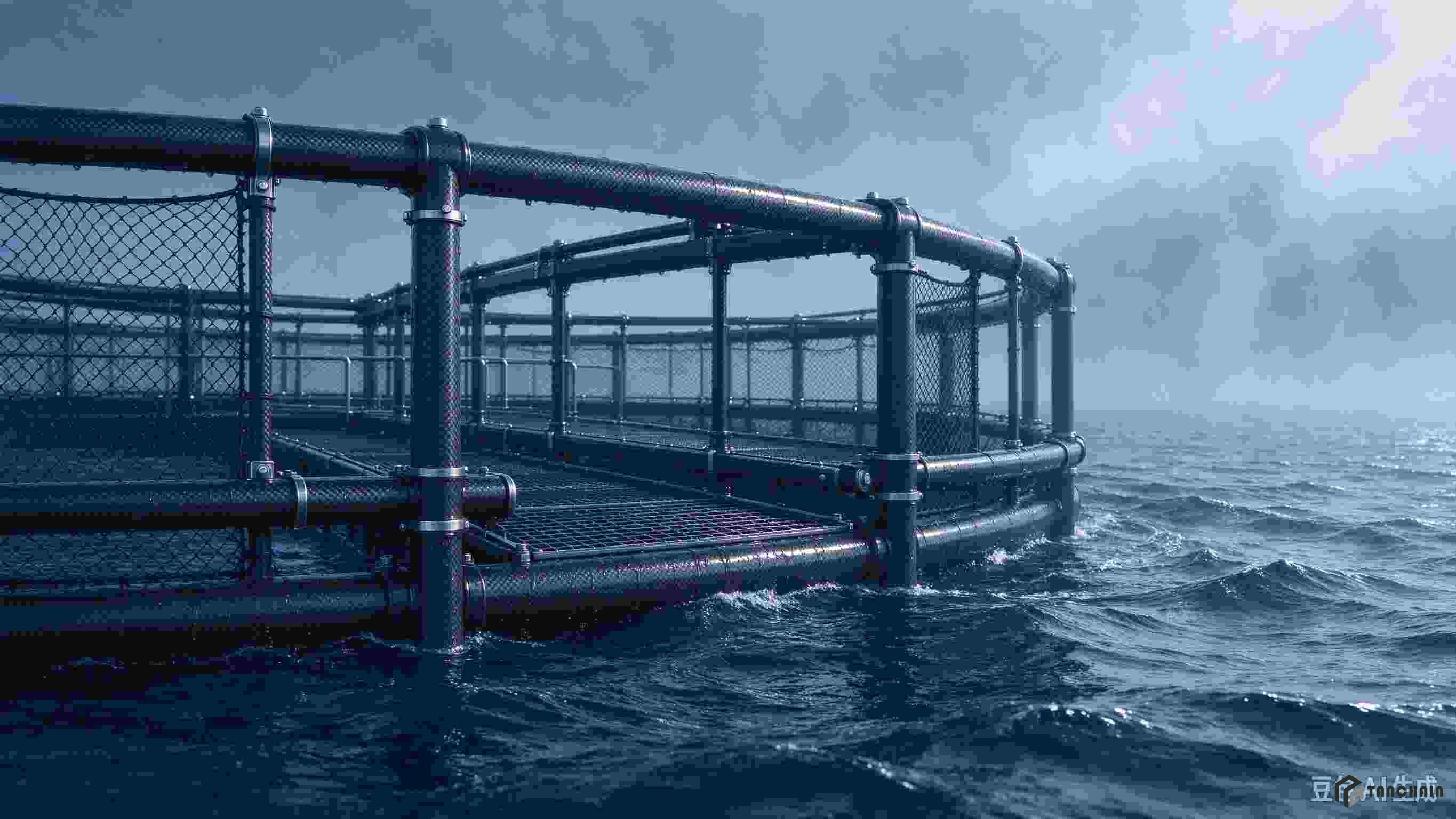
Aquaculture is one of the few industries where the structure has to work while it is being attacked from every direction at once. A sea cage or a land-based tank sits in salt water, is loaded by waves and current, is flexed by tides, is colonised by fouling organisms, is cleaned with high-pressure water, is lifted and inspected by crane, and is expected to last through ten or fifteen production cycles before replacement. Steel corrodes, galvanised mesh loses its coating at every weld, HDPE pipe creeps under sustained load, and timber rots from the inside out. None of that is a maintenance failure in the ordinary sense — it is a material selection failure that has simply taken a few years to show up. This guide explains how carbon fiber composite solutions address the aquaculture problem directly: where they replace metal and plastic, which product form suits each component, how the performance case is built for a marine production site, and what to check before you specify.
1. Why Fish Farming Is a Material Problem Before It Is a Biological One
Stock losses, escapes and harvest delays are usually recorded on the biological side of the ledger. The root causes, more often than not, sit on the structural side. A net pen that deforms changes its internal volume; a walkway that corrodes out is closed for repair at the worst moment in the cycle; a mooring frame that loses stiffness moves the whole cage into a current it was not designed for. Aquaculture engineers who have run sites long enough tend to agree that the material system sets the operating envelope.
1.1 The Five Loads Every Sea Cage, Raft and Tank Must Survive
First, the static load: the weight of the structure itself plus the biomass and the biofouling that accumulates on it, which can double the effective mass of submerged components within a season. Second, the hydrodynamic load: wave orbital velocity and tidal current acting on the largest projected area in the water, which is why current speed at the site is the single most important input in cage design. Third, the fatigue load: millions of small cycles from waves, each of which is harmless on its own and cumulative in effect. Fourth, the handling load: crane lifts, net changes, anchor handling and the occasional contact with a service vessel. Fifth, the environmental load that never switches off: chlorides, dissolved oxygen, UV at the surface, and abrasion from the net and from cleaning equipment.
1.2 Where Conventional Materials Fail First
Hot-dip galvanised steel walkway frames are the classic weak point. The coating performs well on flat surfaces and poorly at cut ends, weld toes and bolted connections, which are exactly the places where salt water collects and stays. The result is not a uniform loss of section but localised pitting that turns into a fatigue crack initiation site. HDPE flotation collars and pipes perform better chemically, but their creep behaviour under sustained hydrostatic load at elevated summer water temperature is a real design constraint, and their stiffness limits how much span can be achieved without intermediate support.
Timber decking on floating walkways is cheap to replace and expensive to own: it checks, splits, absorbs water, gains weight and eventually needs full replacement, usually during the busiest weeks of the production cycle. Concrete sinkers and anchoring blocks are durable but heavy, which raises the demand on the mooring system and the crane capacity needed to service it. Every one of these problems points in the same direction — toward materials whose properties do not depend on a coating staying intact.
2. Mapping Aquaculture Components to Composite Material Forms
Carbon fiber composite solutions are not a single product. They are a family of material forms, and the first engineering decision is which form belongs to which component. The mapping below is the one that has proven most practical on marine production sites.
2.1 Walkways, Catwalks and Service Decks
Pultruded carbon fiber profiles and carbon fiber plates form the structural spine of walkways and service decks: the two main longitudinal beams carry the bending moment between supports, and the transverse members spread the walking load. A bonded and bolted carbon plate deck on top gives a stiff, low-deflection surface that does not rot, does not swell and can be cleaned with the same high-pressure equipment used on the nets. Because the laminate can be engineered to be far stiffer than an equivalent aluminium extrusion at similar weight, support spacing can be lengthened, which removes posts and brackets from the splash zone.
2.2 Floating Frames, Collars and Raft Beams
Carbon fiber tubes in the 40 mm to 150 mm diameter range are the natural choice for buoyancy collar frames and raft beams, where the requirement is bending stiffness over a span combined with low mass. A carbon tube delivers a stiffness-to-weight ratio that lets the frame be lighter without becoming flexible, which reduces the wave-driven inertia that the mooring system has to absorb. For frames that need a combination of pressure resistance and buoyancy, carbon tube with a sealed end cap and a closed-cell foam core is a common arrangement.
2.3 Tanks, Raceways and Land-Based Systems
In recirculating aquaculture systems (RAS) and flow-through farms, the water treatment loop — biofilters, protein skimmers, degassing columns, sumps and pipework ponds — has a materials problem of its own. Seawater, ozone residuals, salt deposits and continuous wet operation attack metal fasteners and supports. Carbon fiber plates and pultruded profiles make stiff, corrosion-free support structures for tanks, heat exchangers and UV units; carbon fiber tubes form the internal frames and diffuser manifolds; and carbon fiber fabric with epoxy is used to repair and reinforce concrete tank walls and raceway surfaces that have spalled.
2.4 Nets, Predator Barriers and Mooring Components
The net itself is a textile decision rather than a composite one, but the frame that holds it, the tension ring that keeps it taut and the connector hardware that joins cage sections are not. Carbon fiber connectors, top-ring sections and tensioning bars keep the net envelope stable in current, which directly reduces escape risk at the corners where net distortion is worst. For the anchor and mooring chain, composites are not the right answer; the value of carbon in aquaculture is in the structure above the seabed, not in the ground tackle.
2.5 Hot Water and Steam Lines in Processing and Hatchery Buildings
Hatcheries, processing halls and feed kitchens run hot water, steam and condensate lines through spaces that are wet and often cramped. Pre-oxidized fiber (PANOX) in sleeve, rope and fabric form is used as a thermal barrier and fire protection wrap around these lines and around the insulation beneath cladding, where conventional mineral wool compresses and loses performance after repeated wetting. Aramid fabric is used for protective curtains and covers in areas where flame resistance matters alongside flexibility and abrasion resistance.
3. The Performance Basis: What Composite Material Actually Buys You
The case for carbon fiber in aquaculture does not rest on one spectacular property. It rests on a combination of properties that no commodity material offers together, in an environment that punishes every weakness.
3.1 Corrosion Resistance Without a Coating to Maintain
A properly cured carbon fiber epoxy laminate is chemically inert in seawater. There is no sacrificial zinc to renew, no coating to inspect and no galvanic couple to manage at connections — provided the design follows the usual composite rule of isolating the carbon from any metal fastener. The maintenance consequence is significant: walkway frames and cage components stop appearing on the annual coating inspection and repaint schedule, which is often the largest single line item in a site's maintenance plan.
3.2 Stiffness and Strength at Low Mass
Carbon fiber has roughly four to five times the specific stiffness of steel and about four times that of aluminium along the fiber direction. In a walkway beam or a cage collar, that translates into less deflection for the same mass, or less mass for the same deflection. On a floating structure, reduced mass is not only a handling convenience — it lowers the inertial load transferred into the mooring and reduces the freeboard change when the structure is loaded by a service crew.
3.3 Fatigue Behaviour Under Wave Loading
Carbon laminates are notably tolerant of high-cycle fatigue in tension-dominated wave loading, which is the dominant loading mode for cage collars and walkway beams. Steel in salt water, by contrast, loses fatigue strength rapidly once pitting has started, and the heat-affected zone at a weld is where that usually begins. In a site exposed to open-water swell, this difference in fatigue behaviour is often the reason a composite frame outlasts two or three steel frames.
3.4 Thermal and Fire Performance Above Water
Above the waterline, fire performance becomes part of the specification. Pre-oxidized fiber is inherently flame retardant, does not melt and does not generate flaming drips; it is used in fire barriers, thermal insulation covers and protective blankets around hatchery and processing equipment. Aramid fabric offers similar non-melting behaviour with higher tenacity and better abrasion resistance, which suits protective curtains, gear covers and handling gloves in the same facility.
3.5 Design Freedom at the Connection Detail
Composite laminates can be laid up and pultruded into sections that already include the flanges, ribs and locating features that would otherwise be separate welded parts. On a sea cage, that means fewer joints, fewer fasteners and fewer crevices where salt and fouling accumulate — which is where steel structures begin to fail.
4. Selection Matrix: Component to Product Form
The table below summarises the practical mapping between aquaculture components and the Tanchain product range. It is a starting point for specification, not a substitute for a load calculation; every component still needs to be sized for its site conditions.
| Component or Subsystem | Typical Service Environment | Recommended Material Form | Primary Selection Driver |
|---|---|---|---|
| Cage walkway beams and decking | Submerged or splash zone, salt water | Pultruded carbon fiber profile, carbon fiber plate | Stiffness over span, corrosion-free deck surface |
| Buoyancy collars and raft frames | Continuous immersion, wave fatigue | Carbon fiber tube, carbon fiber plate | Bending stiffness, low mass, fatigue life |
| Net frames and tensioning bars | Current loading, abrasion | Carbon fiber tube, pultruded profile | Envelope stability, escape prevention |
| RAS tank and equipment supports | Wet indoor, ozone and salt residue | Carbon fiber plate, pultruded profile | Corrosion resistance, dimensional stability |
| Concrete tank and raceway repair | Wet concrete, chemical attack | Carbon fiber fabric, carbon fiber prepreg | Tensile strengthening, crack bridging |
| Hot water and steam line protection | Wet, hot, confined spaces | Pre-oxidized fiber fabric, sleeve, felt | Inherent flame retardancy, thermal insulation |
| Protective curtains and covers | Processing hall, abrasion plus heat | Aramid fabric, aramid yarn | Non-melting, tenacity, abrasion resistance |
| Custom brackets and fittings | Splash zone, mechanical fixing | Carbon fiber prepreg laminate | Design freedom, weight, stiffness |
5. Application Notes: Where Composites Change the Economics
Composite material is not the cheapest material per kilogram at the point of purchase. The payback comes from what happens after installation, and the notes below describe where that payback has been most consistent in marine production environments.
5.1 Walkway Replacement Cycles
A galvanised walkway frame on an exposed site typically needs inspection on a six-month cycle, touch-up repairs every couple of years, and structural replacement within a decade. A carbon fiber walkway of equal stiffness needs inspection for mechanical damage and fastener condition, not for coating loss, and its service life is set by the laminate design rather than by the coating warranty. Where the site is remote and access is expensive, the reduction in intervention frequency is usually worth more than the material price difference.
5.2 Site Handling and Installation
Composite components are lighter than the steel parts they replace, which changes the installation method. A walkway span or cage collar that needed a hire crane can often be installed with the site's own davit or vessel crane, and the number of personnel needed to position it falls. On an operating farm, shorter installation windows mean less disruption to feeding and harvest schedules.
5.3 Repair and Modification
Composite structures can be repaired by local laminate overlay, and they can be modified on site by bonding rather than welding. That last point matters in aquaculture, where equipment configurations are frequently adjusted between production cycles: a deck extension, an additional sensor mount or a modified net frame can be bonded in place instead of being cut, re-galvanised and re-fitted.
5.4 What Composites Do Not Solve
Carbon fiber is not a universal substitute. It is not the right material for mooring chain, anchor blocks, or any component that must absorb large quantities of energy through plastic deformation. It is also unsuitable where point loading and local impact from heavy service equipment are severe unless the laminate is designed with sacrificial wear layers. A realistic specification says where carbon is used, where aramid or pre-oxidized fiber takes over, and where conventional materials stay.
6. Complementary Fibers in the Same Aquaculture Solution
One of the practical advantages of sourcing from a single supplier is that a project can combine fiber systems rather than force one material into every role. Aramid fiber, with its high tenacity and non-melting behaviour, suits protective covers, curtains and abrasion-resistant elements; pre-oxidized fiber suits the thermal and fire protection layer; carbon fiber suits the structural work. Specified together, they cover the structural, protective and thermal requirements of a farm with a consistent and documented material system.
7. Why Operators Specify Tanchain Composite Materials
Tanchain supplies the full range of material forms an aquaculture project needs from one source: carbon fiber filament (tow), carbon fiber tube, carbon fiber plate, pultruded carbon fiber profiles, carbon fiber fabric, carbon fiber prepreg, carbon fiber chopped fiber, aramid filament and staple fiber, aramid fabric, and pre-oxidized fiber in tow, yarn, fabric and felt form. That means a cage frame, a walkway, a tank support structure, a repair laminate and a thermal barrier can be specified as one material system rather than assembled from five suppliers who each optimise for their own catalogue.
Because the components are produced to specification rather than selected off a shelf, the laminate schedule, the fiber architecture and the surface protection can be matched to the actual site conditions — current speed, wave exposure, water temperature and cleaning regime — which is what determines whether a structure survives ten production cycles or three.
If you are designing or refurbishing a sea cage system, a floating walkway, a land-based tank farm or a processing facility, review our carbon fiber composite products or contact us with your site conditions — current, wave height, span, load case and water chemistry — and we will recommend the specific product form and specification for each component. Carbon fiber composite solutions for aquaculture and fish farming start with one correct material choice in the right place.